
This piece, published in Carte Blanche, centres on a day out with two nonagenarians: one of the last excursions my parents and I took together. http://carte-blanche.org/the-perfect-day/
This piece, published in Carte Blanche, centres on a day out with two nonagenarians: one of the last excursions my parents and I took together. http://carte-blanche.org/the-perfect-day/

In the late afternoon, our pale blue boat slipped away from the bleached wooden jetty. Pekka rowed; Markku picked in slow motion through the jumble of fishing gear. No one in the Ålands uses outboards unless they have to, and the absence of human noise is one of the special virtues of the place. You can hear only the birds, the wind in the pine and birch trees, the oars as they dip into the water.
Tuija and I sat on the jetty and watched the boat slip into a narrow channel of deepish water marked by sticks planted in the fine soft mud below. It wove its way between several islands, some no bigger than the boat itself, others half a mile or so in length, and then entered the narrow corridor that passes through the middle of a reed bed. No doubt Pekka and Markku would be disturbing the oily and agile water rats, sending them skeltering to their muddy burrows in the reeds’ matted roots. The whispering reeds, which rise to six or seven feet, cast the water in rich green shadow and the boat’s blue deepened from eggshell to aquamarine. It became more difficult to see, and then, as the passage turned slightly to the left, disappeared from sight. We walked back over the rocks, too hot now for bare feet. The wooden sauna hut cast a welcome strip of shadow.
“We just have to wait, now,” said Tuija contentedly. “If you go off, make plenty of noise because I saw snakes this morning.” She closed her eyes, signalling her desire to enjoy solitude; something every Finn understands. Finland is a relatively empty country, but having so much space seems only to create the appetite for yet more, especially in summer. Life in the almost antiseptically clean cities is highly civilized. The freezing, lightless winters necessitate hermetically draught-proofed buildings: layer on layer of concrete, glass, trapped air and insulation between each person and the world. But here, in summer, the horizon stretches away creating an almost limitless sense of space. The light is intense, very white, and the days are long. At midnight the sky is dusky: by three a.m. it is light again.
We have been on the island for over a fortnight now, spending the hours between breakfast and supper respectfully apart; one with the binoculars, another with a book, someone else in the boat.
Only the largest of the hundreds of Åland Islands have names; this one does not. Like many of the others it is owned by a fisherman. The only sign of modernity is the solar panels on our cabin roof. None of the nearby islands are inhabited by human beings, though plenty of birds set up home.
Opposite, a pair of swans have nested. The nest, about a foot high, is as neat as a wicker basket. The swan sits, statuesque, winding her head watchfully through the whole 360 degrees while her mate swims in shallows thick with tiny fish. Our fish, when it arrives two or three hours later is a three kilo pike, muddy green. It has a bony, tapered head and a huge, sulking jaw. “Go on,” Pekka says to me, “open its mouth!” I’ve never seen a mouth so full of teeth. There are double rows around the edges of the jaw, and then six or seven other rows crossing the roof of the mouth in orderly lines. The teeth are triangular, pointed, hard as bone and sharp as needles. The pike, Pekka tells me, grows new teeth all through its life: as one gets worn down, so another sprouts beside it. Some of them move in their sockets, making it almost impossible for prey to escape.
As if performing a ceremony, we pass the pike from hand to hand and everyone examines it. It still has the sheen of life about it, a green gleam.
“Pike are monsters,” Tuija says, weighing it in her hand. They are the epitome of greediness, she explains. They can eat prey their own size in a single protracted gulp. They are solitary creatures and lurk like death itself in dark places, waiting… the really big ones, which live in the depths of inland lakes can drag you by the line out of your boat or take hold of your leg as you swim after sauna and pull you under. Which is believable: even in death this one looks dangerous. It seems fitting to eat them. Pekka hesitates with the knife poised where the gullet meets the head. Then he slips the point in, opening the fish from head to tail. The innards tumble cleanly out, bar at the ends, where he has to saw and grapple. The teeth, which continue right into the throat, draw blood on his hands.
“Something else you must see.” Pekka picks through the glistening pile of marbled guts and roe. And there it is, a brilliant pure red blob, perhaps an inch and a half long: the pike’s heart, the engine that drives a killing machine. Pekka clears a space. The heart jerks to one side and then another, unconstrained by the organs normally packed around it. “See?” Pekka says, “Even though we caught it hours ago!” And as we watch, the pike’s heart seems to twitch even harder, as if it was an entire creature trying to pull itself towards the edge of the hot stone, over it, and back into the sea. When it does fall still, Pekka touches it softly with the edge of his knife and it begins again. Markku rinses the fish and begins to fillet it. You have to admire his skill, but I do tend to admire the pike’s heart more. On and on it goes, despite being separated from its owner, excavated from the cool dark interior of the pike and laid in full midsummer sun on a dry hot stone.
The fish smoker is an old oil drum burnt clean. Pekka and I fill the bottom few inches with chips of alder, then set the fillets of pike on a rack, which we suspend above the wood chips. We seal the drum with a thick, well fitting lid. Smoking is indirect: we set the drum on stones above a small fire of birch logs. It will take about half an hour, or maybe an hour, depending on how much the breeze disturbs the fire. The others are carrying the table and chairs up to the highest point of the island, a flat plateau of pinkish rock which gives uninterrupted views all round. Beer and wine have been retrieved from the cool spot under the jetty. This is to be our last meal on the island and we have been preparing for it, very slowly, all day. Afterwards we will have our last sauna in the wooden hut by the sea, and in the morning we’ll climb into the pale blue boat and leave the place behind for another year. So at last we sit on our rocky plateau and eat the pike with potatoes and dill. The once fearsome flesh breaks moistly into soft, greenish grey flakes, tasting, beneath the smoking, of pondwater. The sea is, as they say here, greased: flat and shining. On the pinkish grey rock, a succession of yellow and green stripes mark the progressively diminished water levels of recent years. The Gulf of Bothnia: frozen in winter, calm, warm and slightly salty in summer: and perfect for boiling potatoes. We have some salad, a dessert of yellow berries beaten into quark, coffee.
At ten o’clock the sun is still high and golden. Now and then the others lapse into Finnish: it’s a slow language with big flat vowels and a heavy stress right at the beginning of every word, like a heartbeat. And as I watch, a blackheaded gull swoops down over the jetty, seizes something from the stones and rises back into the air. The pike’s heart, I realise, is in the gull’s stomach now. I imagine it beating on, even there.

Copyright © 1994, 2004 Kathy Page
Winner of the Traveller Writing Award 1994
(Closed for 2018)
Depending on other commitments, I can sometimes read a manuscript, or part of it, and provide a written report , along with detailed notes and editing suggestions on the manuscript or Word file. Comments from writers I have worked with below. Please use the contact form for further information
Recommendations
“I enjoyed working with Kathy — a great mentor. Her incredible sense of story and her ability to recognize the heart of a narrative helped me distill my material into work that I am proud of. Kathy transformed the revision process into something dynamic and exciting.” Michelle Glennie, Canada.
“Kathy is a gem – prepared to defend a point, but creative enough to work round an author’s vision. I recommend her highly.” Keith Lord, USA. Keith Lord’s fiction has appeared in Duck & Herring and Dark Sky. He has completed a novel, Bank Street.
“Kathy manages to be both enlightening and inspiring. She has a wonderful ability to go right to the heart of serious weaknesses in a piece of writing without being distracted by more superficial flaws, which, once you correct the underlying problem, will often disappear. She has a fine sense of structure and an excellent ‘bullshit detector’—an invaluable skill. I’d be lost without her feedback.” Vicky Grut, UK. Vicky’s short fiction has been published in many collections including two volumes of the British Council anthology New Writing 13 (Picador) and NW14 (Granta), and Waving at the Gardener (Bloomsbury). Awards for short fiction include the Asham and Ian St James prizes in 1999 and the Chapter One International Short story prize . Her novel is with a literary agent.
“Two years ago when I started writing I told myself that I was doing it for myself. A release, I thought, the same way a girl writes in her diary: Dear Diary, I heart heart Steve, or Dear Diary, I hate my life. Writing was talking to a friend. I would get advice from my parents in Vancouver, my aunt in Halifax, my friend in Montana, and all my friends at home. Is it horrible? I would ask. You can be honest. Everything they told me was contradictory and inconsistent. Except for my mum, to her everything was beautiful. Adorable. Prodigious. What I needed was one person I trusted and respected. One editor that could be honest and tactful, professional and open minded. Because writing is so subjective three opinions was already too many. Kathy Page became that person. I let others read my work, but it is Kathy that I listen to. She never tries to change my style, (if I might be lucky enough to have a style), but rather encourages and shapes what I want to write. She encouraged me to enter the CBC Literary Awards, a contest I was not ready for, and with her help I was shortlisted twice.
When the magazine I wrote for replaced me with a new columnist, she believed I would find a better magazine. Which I did. It is because of Kathy that I feel as though I can write not just for myself, but for the world. Writing is something that should be created, loved, and then thrown into the hands of strangers to stand on its own. Thank you, Kathy.” Tik Maynard, Canada. Read Tik in The Chronicle of The Horse.
“Kathy never fails to understand exactly what I’m trying to do with my writing. She manages to explain in a clear and informative way exactly why and how it isn’t working (and also when it is) which leaves me armed and motivated to continue after every feedback session. Kathy critiques in such an open and positive way that I feel I’m working with an ally on my novel as opposed to a less personal tutor. I love being able to talk about my characters with somebody who knows them as well as I do. Top this with great value for money; I can’t imagine how I could have a better mentoring relationship than this.” Jackie Buxton, UK.
“Thank you again for doing this. I can’t tell you how helpful this process is for me, on more than one level. Your comments are clear and helpful. I’ve really appreciated how you get past the superficial things right to the bones of my stories. That’s exactly the help I need – thank you. And of course for critiquing things on the surface too, where it’s needed.” Rachel Muller, Canada. Rachel Muller’s short fiction has been published by Hitchcock Magazine, and her young adult novels When the Curtain Rises, Ten Thumb Sam and The Solstice Cup are published by Orca Press.
“Kathy Page’s questions open doors of discovery, making it possible to explore, invent, and create, in ways the solitary process rarely invites. Without her fine eye for line editing, ear for dialogue, and deep understanding of the importance of story, I would not have had the courage to experiment with points of view and structure. Her deep commitment to my writing made it impossible for me to give up. She is a mentor without an ego, whose criticisms, generous in detail and scope, make one want to strive for greatness.” Renate Mohr, Canada. Renate’s short fiction has appeared in The Antigonish Review and Room of One’s Own.
“I’ve relied on Kathy Page’s analytical and critical judgement for many years now. She manages to be both enlightening and inspiring. She has a wonderful ability to go right to the heart of serious weaknesses in a piece of writing without being distracted by more superficial flaws, which, once you correct the underlying problem, will often disappear. She has a fine sense of structure and an excellent “bullshit detector”—an invaluable skill. I’d be lost without her feedback.” Vicky Grut, UK. Vicky Grut’s short stories have appeared in magazines and collections including Random Factor (Pulp Books, 1997), Reshape Whilst Damp (Serpent’s Tail, 2000), Valentine’s Day: Stories of Revenge (Duckworth, 2000) and Volumes 13 and 14 of the British Council’s anthology New Writing. Awards for short fiction include the Asham and Ian St James prizes in 1999 and the Chapter One International Short story prize in 2006. Her novel is with a literary agent.


Great review for In the Flesh in the Globe, good illustrations, PDF here: flesh globe review
Text only:
The body: We can’t live without it.
It is as wondrous as it is terrifying, as ridiculous as it is sacred, as familiar as it is ever-changing. Our relationship with our bodies could not be more intimate, and yet most of its everyday, ordinary functions remain deeply mysterious to us. We feel in control of our bodies, until suddenly we don’t.
In their anthology, In the Flesh, Kathy Page and Lynne Van Luven gather together personal meditations on the body. “We had desperately wanted to create an enormous, encyclopedic book that encompassed even the toenail and the appendix,” write the editors, who took their original inspiration from Klaus Theweleit’s observation in his book Male Fantasies: “Historians have never been interested in what has really happened to human bodies – what bodies have felt.”
What do bodies feel? Though we are made in common, each of our bodies constituted of matching parts, it is a question infinitely complicated by the uniqueness of individual experience. In the end, Page and Van Luven settle on 20 essays by 20 diverse writers, each addressing a different body part.
From hair to heart to hands, from breasts to blood to brain, the essays deliver personality along with tidbits of information. “The average human head holds 120,000 strands of hair,” writes Caroline Adderson, but she knows that the real emotion is contained in the particularities of her own experiences: “A heart-shaped chocolate box, paisley-patterned in hot pink. Very 1970s.” The reader cannot wait to lift the lid: “Three long, coppery brown hanks, each secured by an ordinary elastic. … Even now, decades later, the smell of Clairol Herbal Essence is heady.
These essays are at their best when the body part is fleshed out in story. Memorable images linger. Dede Crane writes about her feet bloodied in pointe shoes. Stephen Gauer stares at an image on a computer screen: “My kidneys looked beautiful.” In Susan Olding’s essay on blood, her alcoholic, dying father asks her to open the curtain around his hospital bed: “How tempting to read this as a metaphor – to see it as a sign that he had finally found a way to loosen his tourniquet of shame.”
Olding makes creative use of the many blood images that inhabit our vocabulary, but not every essayist is so skilled. Tedious to read, though compelling to reflect on, are the lists that crop up in many of these essays – of words related to the body part under scrutiny. It seems as if our language is composed of the body itself, though not all parts command respect. Words related to the penis and the breasts are mainly euphemisms for the parts themselves, while other parts are so woven into our language we don’t even notice. Can you give me a hand with this? Don’t get your back up. No, really, I don’t mind.
The most brilliant essay in the book skillfully combines facts, narrative and the language of the body. Lorna Crozier’s poetical meditation on the brain contains images that shock and wordplay that delights, and finishes with a story you won’t forget. Its depth and imagination reveal the weaknesses in a few of the other offerings, those that feel more purpose-written than necessary.
Nevertheless, the book’s overall effect is powerful, occasionally laugh-out-loud funny, and, more often than not, deeply moving. We humans are vain, we decorate our bodies and we strive to alter them with diet and exercise and cosmetics. There’s poignancy in this effort. Our bodies, after all, are not made to last. This is the simple fact of life, the pact we enter into quite unwittingly at birth. There is no life without death.
Despite this – or perhaps because of it – the pleasure we take from our bodies, and in them, can feel utterly transcendent. Effortless as breathing. Try capturing that in a history book.
Carrie Snyder’s second book, The Juliet Stories, was published in March. As a runner and a mother, she is all too aware of her body’s limitations. She lives in Waterloo, Ont., and blogs as Obscure CanLit Mama.
Buy In the Flesh:
In Canada: Munro’s Books Amazon.ca
In the UK: W H Smith Amazon.co.uk
In the USA: Amazon.com

 I’ll admit I don’t normally enjoy having my picture taken, but being in this book, in which portraits and literary extracts sit side by side, has been a pleasure.
It began with a morning spent in the garden talking with Barry Peterson about books and ideas whilst leaning against various trees. This followed by an eventing spent choosing a maximum of 150 words to represent myself with: a throughly entertaining exercise. And now, gorgeous pictures taken the old-fashioned, physical way, gathered together in a book that’s expertly designed and made. Excellent company, and a reading coming up.


 AT THE MIKE ~ The World of Fiction
“Fiction depends for its life on place…” Eudora Welty, The Eye of the Story
Two new novels arrived in the mail yesterday, Rook, by Jane Rusbridge, published by Bloomsbury, UK, and The Apple House, by Gillian Campbell, published by a small but wonderful BC publisher, Brindle & Glass. Both books are fresh from the press, yet also familiar since I read them in early draft form, and edited The Apple House last year. So I have a sense, to varying degrees, what each book contains, yet at the same time, I know that they have changed – a great deal, in the case of Rook – since I last saw them. Wanting to read the real books, as opposed to the work in progress or the MS, to see how it finally turned out, is a very powerful hook, and even though I’m half way through reading Hilary Mantel’s Bring Up the Bodies (At last! It’s wonderful!), I was unable to resist a brief exploratory diversion, and equally unable to limit myself to dipping into just one of these new novels.
I might not have noticed it had the books not arrived together and forced me to read them in concert, but what hits me right away is that both writers have set their stories in watery places which are evoked with exquisite, sensuous detail. Continue reading Waterscapes

TNQ (The New Quarterly) publishes stories and poems by wonderful contemporary such as Caroline Adderson, Patricia Young, Steven Heighton and Mark Anthony Jarman; it was recently shortlisted for no less than five National Magazine Awards. The editors put each illustrated issue together in a beautifully produced book that does not fall apart when you open it, and chose an intriguing title that both connects and enriches the contents. So I’m delighted that my story, “To Make Much of Time” appears in the current issue, 123, The Time of Your Life, along with an essay, “Going Backwards”, that touches on the tricky business of writing fiction inspired by one’s own relatives and family history.
The story is one of a story sequence in progress which centres on the emotional life of one Harry Miles, born in 1919, and at the same time looks at what poetry does, not in a literary sense, but in terms of its influence on the way we live and think about our lives. Each story connects in some way with a particular poem or poet. The story in TNQ, “To Make Much of Time” refers to a poem by Robert Herrick (1591-1764), “To the Virgins, To Make Much of Time”. The poem begins: Gather ye rosebuds while you may… and goes on to warn:
That age is best which is the first,
When youth and blood are warmer;
But being spent, the worse, and worst
Times still succeed the former.

20th June has been proclaimed International Short Story Day – by whom, I’m not quite sure, but the thinking is good: this is the shortest night or shortest day of the year, depending on your hemisphere. UK publisher Comma Press, who emailed me about the day and the celebrations planned, is a passionate champion of the form, which sadly is less than popular with more commercial publishers.
I’m not sure why that is, because the short story really does have it all. It fuses poetry and narrative, can be plot, character or language driven, suspenseful, meditative, funny, sad or all of them at once. In return for fifteen minutes of your best attention, it will crack open a single moment, or offer up an entire life. You can listen to it in its entirety, or absorb it from the page in a single sitting, then carry it whole in your heart.
From the writing point of view, too, short stories come highly recommended. You don’t have to plan. It’s possible to begin with an image, a line, a snatch of dialogue, a character, a feeling – and find the story it belongs to. And the turnaround is so much faster: a novel might take a year or more to draft, but you can have a story down in week, or even a day, then put it aside to read and revise in some slack time three or six months hence. It’s possible to perfect it, and on the way, you can share it easily, ask for an opinion: no-one minds test-reading a few thousand words, and if it ends up in your bottom drawer, that’s all right, too.
 Short fiction was once very commercial, and it may be so again. But meanwhile, let’s celebrate. There are so many wonderful short stories: Chekhov’s “The Lady with the Lap Dog”, of course. “Cathedral” by Raymond Carver. Angela Carter’s “The Bloody Chamber,” “Where Are You Going, Where have You Been?” by Joyce Carol Oates, Italo Calvino’s “The Spiral”. A contemporary short story I recently read and loved was Caroline Adderson’s “Poppycock”, published in the Canadian journal TNQ. The one I loved before that was from the same magazine: “Dialogues of Departure”, by Stephen Heighton. I could go on, and on… But do you have an all time favourite? What is the last short story you read and loved?
Or is it a while since you read or listened to short fiction? If you have fifteen minutes to spare, Comma Press offers some wonderful author readings posted in celebration of International Short Story Day. Long may it continue.

Telegraph-Journal, New Brunswick, Saturday May 5th, 2012
 “In the Flesh, edited by Kathy Page and Lynne Van Luven, Brindle and Glass, 240 pp
In this collection, 20 essayists explore complicated relationships with their bodies. Each writer focuses on a different part of the body and, in so doing, intimately reveals what’s inside and behind it.
The narratives are deeply personal. Sue Thomas rolls her gall- stones around in her hand as she thinks about her pancreas. Stephen Gauer explores organ donation through his own experience of donating a kidney to his granddaughter. In his meditation on skin, Taiaiake Alfred writes of his place in a racist hierarchy. Caroline Adderson considers the centrality of hair to our sense of ourselves, painfully illustrated by her visit to Auschwitz and its room of full of stolen hair.
This collection is not for the squeamish. Margaret Thompson’s reflection on the ear is clever and visceral with a description of someone with a beetle in his ear who “tried to flush the insect out with melted butter.” Trevor Cole’s Eyes is put together perfectly, every word where it should be, as when he describes his young allergic eyes: “The whites were a sickly yellow and bulging out grotesquely, surrounding the irises like rising bread dough.” Eww.
A story about the vagina is written by a man (André Alexis), while Merilyn Simonds writes of the penis, and this switch is an editorial choice that not all readers will agree with. This reader would have liked to read a woman’s perspective on her vagina, as in Lynne Van Luven’s funny and honest account of her conflicted relationship with her breasts.
In all, this collection is a thorough and provocative look at the body, broken down into its messy, beautiful and complicated parts.”
Rebecca Higgins for the Telegraph-Journal
Buy In the Flesh:
In Canada: Munro’s Books Amazon.ca
In the UK: Amazon.co.uk W H Smith
In the USA: Amazon.com
“…powerful, occasionally laugh-out-loud funny, and, more often than not, deeply moving.” Globe & Mail review by Carrie Snyder
“The collection, published by Brindle & Glass, is anecdotal and educational, witty and at times heart-breaking. Its finely crafted writing serves to underline the strange truths of how we inhabit and make sense of our forms, which are created both by nature and culture….” Review in the Gulf Islands Driftwood
“A thorough and provocative look at the body, broken down into its messy, beautiful and complicated parts….” Review in the Telegrpah-Journal
“An amazing approach to memoir through the lens of the miracles of the body…” Story Circle review
Lynne Van Luven introduces the book on Youtube
Buy In the Flesh:
In Canada: Munro’s Books Amazon.ca
In the UK: W H Smith
In the USA: Amazon.com

Language begins in and with the body, and much work has gone into naming all of its many parts, and describing their function and malfunction. But what do we have to say or write about our physical selves, about the complicated way we experience of our bodies? Love them, hate them, can’t escape them… Body and Soul, which focuses on narratives about illness and healing, came out at the end of last year, and includes The Right Thing to Say, a short story of mine about genetic testing. You’ll find it here.

In the Flesh: Twenty Writers Explore the Body, co-edited by Kathy Page and Lynne van Luven, came out in April 2012 and is available as a trade paperback and e-book. I’m biased, of course, but this is a fascinating book and it was a huge amount of fun to put together. Each author’s essay focuses on one part of the body, and explores its function, its meanings, and the role it has played in that person’s life. We think of writers as cerebral types, but here they confront the suff they are made from with candour, insight and wit.
We are doing events for In the Flesh at the moment, and just as happened when Lynne and I were compiling the book, everywhere I look there seems to be a reference of some kind to the body, or a new and startling image of it.

Visual representation of the body may well have begun with a hand print on a cave wall; thousands of years of sculpture and mark-making and a hundred and sixty years of photography ensued. Now we have not only Antony Gormley, but the likes of Orlan and Damian Hirst, who use the body and its products to make their art… Recently, I stumbled across the work of Spencer Tunick, who, ironically given that his second name suggests an item of clothing, creates installations in which thousands of naked people take up similar positions or stances in a land or city-scape, and are photographed. Participants tavel the world to be part of these works and speak of a sense of liberation and a powerful feeling of being connected with others, and also part of something much larger than themselves. As for the spectacle viewed from outside, what to make of it? Why are all the people pink? Does Tunick mean us to think of the gas chambers? How is it to be him, dressed, directing everyone?
Buy In the Flesh:
In Canada: Munro’s Books Amazon.ca
In the UK: W H Smith
In the USA: Amazon.com

Victoria
29th April, 2:30 PM at the Yoga Den, 1311 Gladstone Ave, Victoria, BC.
Readers include Dede Crane, Kathy Page, Taiaiake Alfred, Margaret Thompson, Julian Gunn and Lynne Van Luven.
Salt Spring Island
6th May, 7 PM in Artspring Theatre, 100 Jackson Avenue, Ganges. Sponsored by Salt Spring Books. Readers include Brian Brett, Margaret Thompson, Lynne Van Luven, Richard Steel, and Julian Gunn.
All welcome. Free. Please visit our Facebook page:
http://www.facebook.com/InTheFleshTwentyWritersExploreTheBody
IN THE FLESH is an intelligent, witty, and provocative look at how we think about—and live within—our bodies. The editors and writers in this collection describe, in many voices, what human bodies feel now. Each author’s candid essay focuses on one part of the body, and explores its function, its meanings, and the role it has played in his or her life.
With original essays by Caroline Adderson, André Alexis, Taiaiake Alfred, Brian Brett, Trevor Cole, Dede Crane, Lorna Crozier, Candace Fertile, Stephen Gauer, Julian Gunn, Heather Kuttai, Susan Olding, Kathy Page, Kate Pullinger, Merilyn Simonds, Richard Steel, Madeleine Thien, Sue Thomas, Margaret Thompson, and Lynne Van Luven.
Buy In the Flesh:
In Canada: Munro’s Books Amazon.ca
In the UK: W H Smith
In the USA: Amazon.com
 In the Flesh: Twenty Writers Explore the Body. The idea for a book of writing about the body first came to me over ten years ago, and I worked for a while on it with my friend Sue Thomas. It went through various metamorphoses, lay dormant for a while and then, in collaboration with another friend, Lynne Van Luven, it was distilled into its current form and taken up by Brindle & Glass.
Each writer was invited to choose (or, in some cases, gently steered towards!) a particular body part and asked to write a candid personal essay exploring that part and their relationship with it. The assumption was that writers had to possess (or have possessed) a particular part in order to write about it. However, we abandoned this rule in the case of two very significant parts, as you will see below.
The twenty essays that resulted from our invitations are fascinating and utterly distinctive in content and tone. Witty, sad, quirky, passionate: each one reads beautifully alone; put together, they create a fascinating, multi-dimensional portrait of the human body and our experience of living within it.
Buy In the Flesh:
In Canada: Munro’s Books Amazon.ca
In the UK: Amazon for paperback and Kindle W H Smith
In the USA: Amazon.com
Here’s the contents page: Continue reading In the Flesh
This article about emigration, gardening and family, was first published in Aqua Magazine, 2011 p28 on.
How it Grows
In one of those windy, sunny days when the light and sound levels are in constant flux, as if an exuberant toddler were in charge of the effects, I crouch over my rows of carrot seedlings, thinning them to a centimetre apart and knowing full well that I will have to do the job twice more before things are right. Every year I try and fail to sow them thinly enough. The seedlings are tiny, the first ferny carrot-leaves just appearing, their white stems fragile as hairs. I keep the plucked ones in my free hand to dispose of safely, since crushed foliage of any kind can attract the carrot fly. It’s tedious, finicky work. And at this time of day I should actually be working on my new novel, and I want to, I really, really do – yet here I am squatting in the vegetable patch, an inane smile spreading across my face.
 In the bed behind me are rows of huge lettuces with crinkled deep red and green leaves protecting tender green hearts. To my right, onions, to the left, two kinds of potatoes and three kinds of beans, rhubarb, beets, peas; over by the house, flowerbeds: all of them thriving under current wet then sunny conditions. There’s a greenhouse full of tomato plants over by the rocky knoll, and of course, in between all these areas of cultivation lie vast tracts of weed and wildflower, and round about it, the encircling trees. The whole place hums with growth. What is it with gardening? Why do I love my lettuces so much? Because I do: I love the crinkled gleaming look of them when they are thriving (this variety, Yugoslav Butterhead is as gorgeous as any flower), and I love the almost–sweet, wild taste and the soft yet very definite texture of a just-picked leaf. Naturally, it delights me to be able to avoid the pesticides and the supermarket, to feed my family and friends with what I have grown. And gardening is certainly easier, mentally speaking, than writing books… There’s all that, of course, and yet there is more, too.
To use a gardening metaphor, my family and I transplanted ourselves here from England about ten years ago. Language, climate, and values were in may ways similar, so we didn’t go into transplant shock on arrival, but I have come to realise that while there may be romance and excitement to a voluntary move such as ours, it is also a brutal thing. Even though emigration is softer, less absolute than it used to be before there were planes, phones, the internet and so on, leaving one’s country to make a home in another is a rupture – one that deepens, rather than lessens over time. I miss not only my family – especially, now, my father – and not just certain loved or archetypical land and city-scapes, but also unexpected things such as newspapers and radio programmes, accents, trains and train journeys, certain bushes and shrubs, clothes that don’t shrink, and the relatively high quality of supermarket-baked bread… Emigration disconnects you from the physical locations of your past, and also from the future that would have flowed from that past, had you not left, and so even though Canada, and in particular this convoluted, rocky island, has been kind to me, I sometimes yearn (impossibly) to return.
So, I dispose of my carrot thinnings and then return to the garden to tug out the chickweed and dandelions that have started to grow between the garlic plants. This forest soil, sandy and acidic is not what garlic wants. It takes at least five years of adding compost and manure to darken and develop real fertility. But the summer light and warmth are wonderful, and if, as we do, you collect and store the winter’s abundant rainwater, it will take you right through the dry summer months. The garlic is already tall and as I reach between the stems, the sun warms my back and somewhere out of sight an eagle sings – a strange fluting noise quite incongruous with the bird.
The eagle and its call are emblematic of the West Coast, and I think one of the things I am doing here in the garden is joining myself, literally and symbolically, to a new land. The hours I spend out here working are also hours spent listening to the birds, the rustle of the deer and the wind in the trees. I observe the sky and the way the light shifts and changes, the weather, the quality of the air: I experience the same patch of land, many different ways. I’m learning it and at the same time becoming part of it.
Yet the thing about gardening is that I have done it all my life, and so, despite this garden being so very definitely on the Pacific Rim, a new place for me, five thousand miles away from where I was born, tending it reconnects me to my past. When I am in the garden I am me, now, working with raised beds and fish compost, dealing with tent caterpillars in my fruit trees, sowing peas called Cascadia and beans called Gold Rush; I am also a young woman with an allotment patch in London, the owner of a window box and then of a thin, shade-free hundred foot slice in Norwich, of a shady square, of a rubble-ridden rectangle in Tooting Bec – I’m all of those, but most of all, but I’m a child, being shown by my father how to weed properly and how far apart to plant the peas.
There was a magnolia tree in the front of the house I grew up in, and Dahlias, plagued by earwigs, grew to one side of the path that led to the front door. Most of the garden was at the back, and it included both a tree-house built in a pussy-willow tree, and a swing set close by a laburnum, the flowers and pods of which I was frequently reminded not to eat. There was a peach tree on the south facing wall of the house, a hazelnut, and several apple varieties. A bed of azaleas and rhododendrons (which grow wild here) was treated annually to maintain the correct PH. Behind that was a mysterious, key-shaped area surrounded in an ancient yew hedge that had been part of the grounds of the manor house on which the subdivision was built.
The vegetable garden ran down the left side, from the kitchen to the swing, and was my father’s domain: the plants in workmanlike rows, the soil turned each spring. Before meals, my sisters and I would be sent out to pick. We were taught how to do that properly: how to find the runner beans amongst the foliage, and take them before they got tough; how to feel the pea pods and judge what was inside, to turn potatoes without spoiling too many with the fork, to rub the soil away from the tops of the carrots so as to make sure they were worth pulling, and judge the ripeness of fruit. One of the best things was picking a peach, cupping it in your hand and turning gently until it came free.
My mother was in charge of storage: we wrapped lettuce or chard (which had to be picked or it would bolt) in damp newspaper before we put it in the salad drawer, and kept roots cool in a mini-cellar by the back door. Apples and pears were wrapped in newspaper and stored in boxes in the garage. Convenience food was increasingly available, but we had none of it.
My father commuted daily to his office job. My parents came from the inner city and grew up with untended, postage-stamp sized gardens, and none of our neighbours grew food. But it was what we did, and it’s what I do now. There’s no peach tree here, but I’ve shown my children (and my husband) many of the things I was taught.
The wind picks up. The broad beans, which here we call fava, need staking – that’s what I’ll do next, and before I go in I’ll pick rhubarb and some salad greens: lettuce, spinach, rocket – which here is called arugula.
My parents tended that first garden for over fifty years, their second, for less than ten. My mother’s gone, my father no longer digs and hoes. But I call and tell him week by week, what I am planting, how it grows.
It’s because of you, I tell him, that I’m on my knees in the dirt.
I think that’s as it should be, he says.


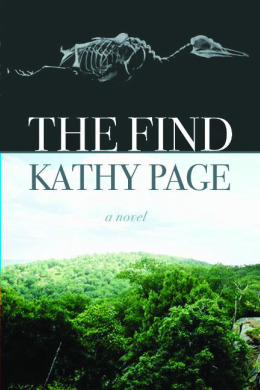
A day’s prospecting leads palaeontologist Anna Silowski to make an extraordinary discovery in a remote part of British Columbia. At the same time, the tensions below the surface of her successful career are exposed. Pushed towards breakdown, she finds herself unexpectedly dependent on high-school drop out Scott Macleod, and recruits him to help on the excavation of her find. Scott the excavation itself teeters on the edge of disaster. The Find is a compelling story about discovery, inheritance and fate, and a moving exploration of the possibilities that hide within a seemingly impossible relationship.
“Kathy Page is one of our most daring writers. Once again she delivers a riveting, superbly paced novel of great complexity. Like a palaeontologist herself, she chisels away at the layers of a story that initially reads as a thriller, meticulously and precisely laying bare the tender love story underneath. If you don’t know Page’s work yet, she’s a find.” Caroline Adderson, winner of the 2006 Marion Engel Award, author of Pleased to Meet You, Sitting Practice and A History of Forgetting.
“Kathy Page reminds us what a novel can do that almost nothing else can: take elements as different as dinosaur hunting, landclaims, inherited disease, and abuse of power, and link them with grace and necessity. Above all, this is a love story of the rarest kind: one with something new to say.” Fred Stenson, Giller-nominated, award-winning author of eight novels, including The Trade & The Great Karoo.
Playing with genre is a feature of Page’s writing. Of Alphabet, she said: “Most crime stories are full of suspense, and end with the criminal being caught and incarcerated. Alphabet is about what happens after the sentence – no crimes, no chases – and I wanted it to be just as gripping.” In The Find she has combined an adventure story with a novel of ideas, and created something new: “What is the ‘real’ story here?” she asks. “Some readers may prefer one or the other aspect of the book, or think they do – and then be drawn into unexpected territory. For me, it’s a story about discovery, and all that means.”
“The Find offers the best of all worlds: descriptions that draw you in without distracting from the story, realistic characters who face difficult choices, and a complex plot that keeps you turning the pages until the very end—with the added bonus that it’s published on one of the greenest types of text paper available…” Full review at:
http://shereadsandreads.blogspot.com/2010/11/green-books-campaign-review-find-by.html
“The clash of conflicting desires, subterfuge, uncomfortable triangling and a profound difference in values with regard to the past, all keep us turning the pages… And the abundance of information about pterosaurs, archeology, native political struggles, academic rivalry, alcoholism and Huntington’s disease is woven into the story seamlessly, only adding to the pleasure of its satisfying, un-clichéd conclusion.” The Globe & Mail review of The Find

In the “bio” section of this site, written way-back-when, I begin by suggesting that that my desire to write springs from “my father’s love of books and my mother’s habit of exaggeration.” It’s true that these were both huge influences. I remember Dad, on his birthday, giving me Beatrix Potter’s The Tale of Peter Rabbit, and how my desperation to unlock the words it contained (combined with my big sister’s patience) drove me to learn how to read, well before school even began. Later on, I used to go and meet my father when he reutrned from work at the end of the day. Looking downhill towards the railway station, I could see the other men, smartly buttoned up, stride homewards, their briefcases clutched rigidly in one hand, their eyes looking forward to their destinations. Dad, his coat or jacket open, was always right at the back of the group, increasingly left behind as the main group surged up the hill. He did not stride, but ambled towards me, the book he had been reading on the train still open in his right hand, still reading as he walked. It was almost a shame to greet him. On holidays, the pari of us haunted second hand bookstands, and shared the same books: thrillers, sea stories, classics. I remember sitting up way past my bedtime while Dad wrote out the titles of books he thought I’d enjoy.

I could say much more about my father here, but my mother died recently, and, as is the way when someone is lost, I have been thinking a great deal about her and how she shaped my life, and especially my writing life. What I described as her habit of exaggeration was a wonderful thing. She never wrote (other than letters) but she had a writer’s instincts. She knew how to make a story better by knocking out the distractions and upping the ante, and she knew how to make you notice her words, which were rarely bland, but often suggested a story, a drama of some kind. If one of us was late for a meal, we had vanished, or absconded. It never merely rained – there would be a tempest or a deluge. These words came aloud in your mouth and in your mind.
As well as modeling this vital skill, my mother continually encouraged us (and in turn, our children) to imagine and pretend. Looking at the family photographs and slides my mother kept is a powerful reminder of this apprenticeship in the extended kind of pretending that I undertake as a novelist. I was encouraged to talk to statues, animals and imaginary beings of many kinds, and sometimes she would join in this too. My friends and I dressed up, made houses in trees, on the coal bunker and under the table, and for the duration of the story we took our meals in role. We were allowed to play out our fantasies until they finally bored us or turned into something new. I think Mum encouraged imagination because she enjoyed it herself. What would it be like to have musical genius in the family? To fly first class? To live in a mansion?
Occasionally, her generosity backfired on her, for all this exercise to my imagination made me quite a good liar, too. I convinced her of the existence of a school play, for which she duly made my costume and in which she believed until the day of the performance was upon us, and later, as a teenager, I set off with a backpack saying I was going to volunteer on an archaeological dig (and did, briefly, appear at the site), but spent the rest of the week in a tent with my boyfriend.
My mother was my first reader, and always appreciative; her suggestions for improvements were often excellent. She was a good typist and keen to add a professional touch, and also prepared to push me into action when she saw the need.

When school sent around a flyer encouraging all pupils to enter a national children’s writing competition sponsored by Barclay’s Bank, she was determined that I should try. The brief for the contest was to write a short story set in a bank.
“You should do this,” she told me. “Nothing to lose. Look at the money you could win!” In principle, I was willing. The year before, there had been a story contest sponsored by The Royal Missions to Seamen, for a science fiction story. I had enjoyed writing my brooding piece about Cody, an astronaut who slipped out of the spacecraft and launched himself into outer space (and certain death) in order to experience something I called Freedom. J.G. Ballard had picked my story, and signed his book Vermillion Sands for me… Yet science fiction was one thing and banks were quite another: set in a bank?
Had I been more politically aware, I might have come up with something to do with Apartheid, given that Barclays was, at the time, heavily criticised for trading in South Africa. As it was, the only potential I could see was in bank–robbery, which everyone would do.
“Have you started it yet?’” Mum asked a few days later; she had a fair bit of time on her hands with just the one rather self-sufficient child to look after.
“Banks are so boring,” I told her – and as the words slipped out, a story came to me: two male bank employees, one in London, one in a place I rather vaguely called Africa, both bored, bored, bored. A memo comes around, offering the opportunity to exchange posts. Both bored employees jump at the chance, only to discover, once they have made the break and taken over each other’s lives that they are bored, bored, bored, the food is dreadful and they miss their friends! I got it down as quickly as I could, and handed the scrawled sheets to Mum.
‘They won’t like this,” she said, “I mean, suppose you were them!” All the same, she typed it out at 70 wpm and, to give the bank credit where it is due, some months later a congratulatory letter and a cheque arrived. Really, my career has never been so simple or so successful since…

Mum’s own work life as a secretary at the BBC had ended when she fell pregnant for the first time and was therefore automatically dismissed, as per normal in the 1940s. She enjoyed all her girls’ careers, and took great pleasure in my book reviews, appearances at literary festivals and so on, especially if international travel and decent hotels were involved. Until the last decade of her life she was too busy to be a great reader of books, but she read each of mine, and congratulated me on it in detail, often surprising me by what she saw in it. My most recent book came out only a few months before her death and after it, when I let myself into the suddenly empty house, the book was still on display on her hall table.
We tend to simplify and idealize the dead, and perhaps in doing so we do both them and ourselves a disservice. So I will say here that it was not all dressing up in a sunlit garden. My mother was a powerful woman, a vivid, magnetic personality, and also a fighter, not at all inclined to doubt. There were periods of difficulty and conflict in our relationship, though fortunately we eventually got to the point where we could joke about them. As a writer, I thank Mum for the difficult times, too. An unintended gift, they taught me some of the most important things I know: how complex and contradictory we all are, how anger can be a kind of caring. How hard we cling to each other. How vital struggle is to any story, and how deeply we yearn for its resolution.
Now, she has vanished.

 This section is still in progress. In the posts to follow you’ll find examples of memoir, creative non-fiction, humour, travel writing and so on, along with (eventually) information about scripts and my earlier novels, Back in the First Person, The Unborn Dreams of Clara Riley & Island Paradise.
But why not start here with It can happen to anyone fed
a humourous essay about the need to go beyond A Room of One’s Own, as re-published by the BC Federation of Writers.

What’s the point of fiction? Why make things up?
Throughout history, some people (and Plato was certainly one of them) have distrusted fiction. Periodically, and often when in the grip of a repressive government or ideology, a whole culture seems to go through a phase of feeling that way. If it didn’t really happen, the argument goes, it’s not a fact. And if it is not a fact, it must be the opposite: a lie or an illusion, and therefore of no value and quite possibly harmful, should you start to believe in it, or use it to distract yourself from reality.
Too much pure entertainment or outright escapism may be unhealthy, but in my opinion there’s nothing essentially wrong with it , though that’s not what I want to talk about right now. I think that fiction is one of the most useful things we have, precisely because it’s fabricated. One of the many things all good stories (real-life or made-up or in between) do is prompt us to think and imagine beyond our actual experiences and the choices we have made. When I engage with other lives, situations and choices—including imaginary ones—I expand my understanding and I often find myself thinking with greater clarity and passion and excitement about my own life. I become more aware; I make comparisons and connections, stretch my sense of what is possible both out there in the wider world, and for me in particular. I may even find myself striving to make more satisfying choices, to engage more with who and what is around me, to express myself more completely, or aim higher – in short, to write a better story for myself. The desire to see some kind of satisfying shape in one’s life is a basic and powerful one.
But don’t we have enough real-life stories to satisfy us, reality being so much stranger than fiction, after all? Continue reading Why fiction?
Kathy Page’s short fiction has been widely anthologized, translated and broadcast on BBC Radio. A new collection, Paradise & Elsewhere will be published by Biblioasis in April 2014.

“The rubble of an ancient civilization. A village in a valley from which no one comes or goes. A forest of mother-trees, whispering to each other through their roots; a lakeside lighthouse where a girl slips into human skin as lightly as an otter into water; a desert settlement where there was no conflict, before she came; or the town of Wantwick, ruled by a soothsayer, where tourists loose everything they have. These are the places where things begin… New from the author of The Story of My Face and Alphabet, Paradise & Elsewhere is a collection of dark fables at once familiar and entirely strange; join the Orange Prize-nominated Kathy Page as she notches a new path the through wild, lush, half-fantastic and half-real terrain of fairy tale and myth.”
“Kathy Page embraces and illuminates the unknown, the creepy, the odd, the other and the rest of us. Her unforgettable prose is moody, shape-shifting, provocative and always as compelling as a strong light at the end of a road you hesitate to walk down…but will.” Amy Bloom
“This vibrant, startlingly imaginative collection reminded me–as few collections have done in recent years–of both where stories come from, and why we need to tell them. Kathy Page is a massive talent: wise, smart, very funny and very humane.” Barbara Gowdy
Early stories are collected in As in Music. Her story The Second Spring After Liberation was awarded the Bridport Prize for short fiction in 1994.
 As in Music
By turns poignant and bizarre, shot through with unexpected humour, but also provocative and disturbing, these stories negotiate a skillful path through the border territory between realism and fantasy. In “Just Dial This Number,” Madeline, anger personified, fights a losing battle against the onset of love; in “The Silver Man,” a teenage mother struggles to come to terms with her baby son. A haunting and eloquent collection of short stories, which confirms Kathy Page’s power and versatility as a storyteller.
‘A collection of writings which, through a sophisticated cast of lost souls, studies the meaning of love, civilization, sex battles and kissing. Funny, poignant and bizarre by turn.’ New Woman
‘Accomplished and imaginative stories….show that Page can be every bit as good as Ballard.‘ The Guardian
‘Page has a rare insight into those moments when characters confront the shape and meaning of their lives. The writing is sparse, often bleak, but always poetic and provocative.’ The New Statesman
‘Page’s style is scalpel sharp.‘ The Observer
Canadian Notes and Queries, 2013
The New Quarterly, 2012, 2013
Ars Medica, Fall 2009
Great Expectations, eds.Crane & Moore, House of Anansi 2008
Gas and Air, eds. Dawson & Daly, Bloomsbury, 2002.
10 British Women Writers, ed Barbara Puschmann-Nalenz, Reclam, 2000.
Signals, ed. Jane Rye, London Magazine Editions, 1999.
Cheatin’ Heart, eds. Longinotto & Rosenthal, Serpent’s Tail, 1999.
Wild Ways, eds. Margo Daly & Jill Dawson , Sceptre, 1998.
New Writing Six, eds. A.S Byatt & Peter Porter, Vintage, 1997
The Bridport Prize Anthology, 1996
New Writing Five, ed. Christopher Hope and Peter Porter, Vintage, 1996.
Back Rubs, ed. Alison Cambell et al, Serpent’s Tail, 1996.
Class Work, ed. Malcolm Bradbury, Heinemann, 1995.
The Bridport Prize Anthology, 1994
Outsiders, ed. Michel Blackburn, Sunk Island, 1994.
The Wild Woman Reader, ed. Sue Thomas, Overlook, 1994.
Best Short Stories 1993, eds. Giles Gordon & David Hughes, Heinemann, 1993.
New Writing Two, eds. Malcolm Bradbury & Andrew Motion, Minerva, 1993.
The Minerva Anthology of C20 Women’s Writing, ed. Judy Cooke Minerva, 1992

 “Page’s imaginative powers are electric. She has the ability to analyse the often nightmarish qualities of the human psyche and as a result, Frankie Styne is a taut examination of the complex emotional ties that bind, the methods we employ to distance ourselves, and our ambiguous powers of imagination. She is at once poignant and provocative, stomach-churningly distasteful and yet compulsively readable.” Time Out
Biblioasis re-published this novel in Canada and the US in 2015. First published by Methuen UK, in 1990.
Frankie Styne, the successful author of a series of gruesome killer novels, has lived at 125 Onley Street for many years. Meticulous and obsessive, he lives a life of isolation, managing to keep both future and past at bay.
Next door, live Liz Meredith and her new baby, Jim. Liz has been told by her social worker Mrs Purvis that Jim has a rare disorder, and will never be like other children. But Mrs Purvis can’t see, as Liz can, that Jim already knows things no ordinary person could. Besides, Liz doesn’t want any help from the social services or from Tom and Alice, the couple at number 129. She wants to be left in peace so that she can imagine her way out of how things are.
When Frank’s solitary anonymity is threatened, he hatches a real-life plot which, as he begins to enact it, unexpectedly changes not only his own life, but also those of Liz and Jim. Sifting through our collective nightmares, Kathy Page has written a novel that is powerful, humorous, tragic and thoroughly surprising.
“Frankie Styne & the Silver Man resists being put down for the night.. I read on, captivated and creeped-out. But this being Kathy Page, I always trusted I was heading away from a nightmare, towards a happier place. This is Felicia’s Journey, with a big dollop of hope.” Caroline Adderson, Giller-listed author of Pleased to Meet You & winner of the Marion Engel Award.
“Fresh and engaging. Her writing is crisp and her insights into human behavior are acute.” Lynne Van Luven, Monday Magazine
“Great story. Great writing too. You render down the monstrous, gently fold the abnormal into an embrace and make it human… fantastic!” Helen Heffernan 


 The Find, May 10 2010, at ArtSpring Theatre, Salt Spring Island, BC, 7:30 pm.

For those contemplating, or already embroiled in, a novel, Workout for the Novel offers a series of exercises to help you think through and develop your idea, as well as an invaluable forum for feedback and discussion. Each week we focus on a particular aspect of the novel you are developing: your main characters, the best place and way to begin the story, overall structure, plotting, voice, and the structure and use of chapters. Some of the exercises generate writing that might later be used or incorporated into the novel and some are writing/think-pieces about the novel in progress which help you to see it more clearly. Students are in small groups of four to six. The course is open to beginners and more experienced writers alike, and it is equally useful for first draft or revision. Allow at least four hours a week – but remember, those hours can be whenever, wherever and however you choose!
$225 for 8 weeks
Please use contact form on the menu to the left for further information. You can also use the RSS feed (above) to keep in touch about future courses
[wp_cart:Workout for the Novel with Kathy Page:price:225.00:end]
[show_wp_shopping_cart]
“An excellent course. It was informative and stretching, certainly, to help me think outside the box. I feel I got a real sense of how to construct a novel, and just wish I’d done this ten years ago!” – Sue Goldswain, Victoria, BC, 2009.
“I felt I needed to do some revising of my story but was overwhelmed at the prospect and found it impossible to view it objectively. The exercises were very good. They provided a ‘way in’ to my story and also helped me to reflect on the nature of a novel. I now feel I have a framework on which to build a future novel, and expect to refer back it frequently. I loved all the feedback. The other writers while honest looked for the positive and their enthusiasm was catching. Perhaps the most useful thing was the questions. Kathy’s comments were incisive and thought–provoking. I liked the intensity; getting weekly feedback was highly motivating.” Gillian Campbell, 2009 Workout participant. Gillian’s novel has been accepted for publication by Brindle & Glass.
“I’ve found this course hugely beneficial. It’s helped me, through the well thought-out tasks set each week, make step by step progress with developing a broad, overall view of my novel as a whole living, malleable “thing”… I’ve asked myself lots of questions, been asked lots of questions, and been prompted by the tasks to come up with ideas and answers in a way that I wouldn’t have managed on my own. I started this course with a handful of random scenes, only a few months into writing this first draft. I now have a much more focused sense of where the novel might be heading. It’s given me an energetic “kick” start, which is just what I wanted.” – Jane Rusbridge, UK, author of The Devil’s Music, Bloomsbury, 2009.
“The course has been wonderfully helpful. As a totally novice writer I did not have the framework to start attacking the rewrite. The exercises are very good challenging, informative. As for the group feedback ‘If somebody calls you an ass, you can tell them to go to hell! But if 10 people call you an ass, get a saddle!’ (I live in Texas!) It’s really true in any creative discipline.You have to know what others see in what you created.” C. Ellen Hart,Texas, 2010
“I’d rate the course as excellent for anyone serious about tackling a novel. The weekly exercises encourage the budding novelist to wrestle with many of the major, practical considerations required to get the project underway, and to try solutions that work for them and the particular story they have in mind to tell… Absolutely the best thing you did for me was to use the ‘track changes’ option to edit my chapter on the fight between the rat and the dog. I saw the difference in the power and simplicity immediately and have both versions on file for future reference when writing scenes that ‘show.'” David, 2009
Deeply, deeply engaging. It made me think about many issues that I simply did not know underlie the craft of writing a novel. It allowed me to participate in a community of like-minded peers who are living the struggle and joy that I am finding in writing. It taught me a great deal about the discipline I need to move from an initial idea to a finished work.” – Roelf Woldring, Toronto, 2009.
“The course far exceeded my expectations. With each exercise I found I moved a step forward, which, in my experience of this difficult process, is quite an accomplishment. In writing my own submissions, I was forced to face some of my weaknesses, which I do a ridiculously good job of ignoring. Reading the submissions of my group members, was instructive as well – it’s so much easier to spot the errors in the writing of others. That having been said, it also makes it easier to return to your own work and face the same issues with a renewed understanding. The site was very user friendly. In terms of your responses it worked well for you to wait until we’d all had our say. You have a real talent for cutting to the quick in a most charming and supportive manner. It’s quite astonishing how you do it.” – Renate Mohr, Ottawa, 2009.
“The course was fabulous for me. I didn’t really know how to approach writing my book, what key pieces I needed to think through. Now I am in a totally different place, and ready to sit down and start writing. I found all of the weekly exercises very useful, as well as the order in which the exercises were given. Each one oriented me to key pieces of writing my book. I really appreciated your direction each week on what kind of feedback to provide to my group members. Your input was very directed and specific, and I felt either confirmed my instincts or provided me with a very effective lens from which to view my book.” – Karen Clark, Salt Spring Island, BC, 2009.
“I loved it. I looked forward every day to new postings. Found it quite demanding but that was good. I was worried that I would never get my novel right and the course made me see that a close third viewpoint and present tense would make all the difference. I learned to trust the input of the group and to see things as a reader would. I learned a lot by trying out different approaches, looking at plot, character and so on, in depth, revising the first chapter, killing my darlings. Suddenly realised how to end the novel in a convincing way, which was wonderful. I felt that you looked long and hard and gave advice that was thoughtful and considered and fairly easy to assimilate.” – Jackie Jacques, UK, author of Someone to Watch Over Me, Piatkus Books.
“I thoroughly enjoyed this course. I learned basic concepts, and got specific ideas for ways to improve my own work. The site worked very well, no problems. It was easy to navigate and was well organized. I enjoyed reading the general discussions, liked the diversity of opinions. The weekly sessions were all useful, and took me through the basics of novel writing, from using description to developing character to pacing the plot. The format of completing a weekly task, then posting it for the group, then giving and receiving feedback, kept me on track.The order of the sessions was particularly well thought out, starting with a general overview of our original plan (in a fun way!), and ending with a map of where we now intend to go. The most useful for me was week #4, structure because I hadn’t really considered that enough before. The most daunting was week #6, chapter, because it suddenly brought all the various elements together. I was amazed at all the thoughtful and insightful comments I received. There’s an opportunity to learn from both giving and receiving feedback. It was nice to have a small group because it takes a fair amount of time to read others’ work – although I found taking time to read critically was valuable to me as a writer.” – Anna Wozniak, Victoria, 2009.
“I really enjoyed the course. Working fulltime and writing on the subway to and from work meant that the online/anytime schedule really helped. The site does everything it needs to do in a simple easy to understand format. The best insight I received was on the pacing and detail of the exercises where you had us create scenes. I really enjoyed your approach as well as learning which authors you follow & respect and I really appreciated your comments on my chapter – extremely useful. Thanks for your invaluable feedback and advice.” – Francis Vanderhoven, Toronto, 2009
“My overall feeling about your course is that it was wonderful. I finally saw the light and that was thanks to your repeated comments that I had to concentrate on people doing and thinking things. The course worked extremely well for me and I enjoyed everything about it. The group I was in worked fine for me. Their comments on my work were thought-provoking and helped goad me on to make improvements, but your comments were my break-through. I suddenly feel I know exactly what I should be doing. I just have to get busy and do it.
Regarding structure and function of the site, it suited me just fine. I would rate it vg and I would also rate the weekly sessions and exercises vg. It seemed to me they led me on in a logical manner until I finally saw the light.” – Catharine Dixon, Ontario.
“I came to the workout with an idea and now have the first chapter and a clear path to the end.” – Michelle Glennie, Montreal, 2009.
“The course far exceeded my expectations. With each exercise I found I moved a step forward, which, in my experience of this difficult process, is quite an accomplishment. In writing my own submissions, I was forced to face some of my weaknesses, which I do a ridiculously good job of ignoring. Reading the submissions of my group members, was instructive as well – it’s so much easier to spot the errors in the writing of others. That having been said, it also makes it easier to return to your own work and face the same issues with a renewed understanding. The site was very user friendly. In terms of your responses it worked well for you to wait until we’d all had our say. You have a real talent for cutting to the quick in a most charming and supportive manner. It’s quite astonishing how you do it.” – Renate Mohr, Ottawa, 2009.
“It was absolutely fabulous!! I found it all both fascinating and extremely useful, and I’m SO glad I signed up for it. I came to love the women in my group and I hope to keep in touch with them. Our projects were certainly different, but there was a lot of overlap and connection. They were all very insightful and supportive, keen-eyed but kind; they pointed out many useful elements in my work and I also really learned from reading their comments on everyone else’s work.I am a bit of a techno-peasant but even I found my way around the site after a while. Whenever you suggested questions (to ask of ourselves or the others) I found they provided important keys into the writing. Nothing was redundant. I learned a tremendous amount from the group’s posts, both on my work and on everybody else’s. Also, analyzing their work was great for stretching my novelizing (sorry!) muscles. Although I’ve been editing books for years, they’ve mostly been non-fiction, so scrutinizing things like plot structure and point of view were somewhat new to me. You always had very useful and relevant things to say. I don’t know how you had time to do it all!:” – Marlyn Horsdal, editor, Salt Spring Island, BC. Marlyn’s novel Sweetness from Ashes was published by Brindle & Glass in 2010.
Here’s a humourous essay about the need for a dedicated workspace first published way-back-when in Finland, and recently republished in WordWorks. Shortly after the events described, I did graduate to an out of home office, and have not looked back since…
My office is on the top floor of the house. Windows look over gardens and treetops; there are books along one wall, a fireplace, and a photograph of the Earth seen from Apollo 10. Its one disadvantage is that it is in my home. This means that I have to discipline myself to disregard whatever is happening or might need doing downstairs in order to get up to it: although hard, this can be done. It also means that the carpenters, plumbers and other noisy tradespersons often needed to deal with an old and previously neglected house must be organised so as to be here when I am not trying to work. This, it seems, is impossible, and so here I sit on a Monday morning, ready to explode.
Ken and Michael, the decorators, who failed to come two weeks ago, when we were on holiday, and failed to come again last week, when I was researching media coverage of the moon landing in the British Library, arrived at 8 a.m. They will be working in the kitchen on the stairs and on both landings. I explained about writers and their offices, how very passionate they feel on the subject. I really shouldn’t worry, Michael said, rubbing the greying stubble on his chin. Really, he said, I wouldn’t know they were here! Meanwhile they were desperate for a cup of tea.
When I entered my office, there was a large, sheet-covered pile of kitchen cupboards in the middle of it. I squeezed past, sat resolutely at the desk. I told myself not to be fussy about the muffled thumps and curses from downstairs and attempted to think myself back into the part of my novel concerning the disappearance of the red-haired girl, Natalie, who was crossing a field at dawn last time I wrote about her… She has been up all night, watching the moon landing on television and is trying to find her way back to the campsite. Meanwhile –
Michael knocks. He wants me to come and take a look at the plaster work on the first landing. It’s shot, he says. What should he do about it? I, being a writer, don’t know. He phones his boss, then abandons the lower landing and sets about sandpapering the cupboard doors on my landing. This is not a bad sound, rhythmical, steady, though he does keep interrupting it to cough, or mutter to himself.
Half an hour passes, during which I manage a paragraph or so of Natalie’s thoughts as she crosses the field. I’m about to cut back to the campsite, when Ken shouts for me from the bottom of the stairs. I thread myself past ladders and trestles, descend cautiously to ground level. Whereas Michael is potato-round and softly spoken, Ken is thin and has an aggressive bark of a voice. Should the tiles go this way or that way around the window? This way? I guess. You’re a writer! he states, putting the tiles down, folding his arms across his chest, leaning against the wall. I think I know what’s coming next, and I’m right: he has had a very interesting life and he is sure it could be turned into a book. For example…
Forty minutes later, fully informed about Ken’s birth by caesarean section, the family’s various moves around the country and their brief emigration to Australia, his father’s collection of model airplanes, his own period of fantastic wealth in the nineteen-eighties, the band he plays in, his recent failed attempt to set up a computer business, his wife’s exercise regime, his father’s death and his children’s problems at school, I manage to extricate myself in order to answer the doorbell. It’s fast-talking, barrel-chested Gary, the Boss.
Since I last saw him three days ago, Gary has severed three of his fingertips during an attempt to adjust a lawnmower while the blade was still moving. These fingertips have been re-attached by microsurgery. One has a steel pin through the top, which, he informs me with relish, keeps catching on the indicator stick when he is driving. Sensation has returned to the fingers. He wiggles them. We examine them in detail. They are a kind of purplish black; the skin is flaking and the nails have fallen off, but, he assures me, they are doing very well. We proceed to the plaster work, examine that in much the same way and negotiate a price. I leave him and Michael arguing on the stairs and return to the office.
The point of Natalie’s journey through the field eludes me and I’m finding it quite hard to even remember the names of my own characters, so I put on some music to drown out the voices, abandon the computer and write the names of my characters on a big sheet of paper, with arrows indicating the important relationships. This seems to work. I feel I’m on the verge of having an idea for the climax of the scene after the one in the field, but then Gary pushes the door open without knocking.
Sorry, I forgot, he says. With all that extra work, I better warn you that we’ll have to go well into next week.
No, I tell him. Please. Gary likes please. As a favour, he says, he’ll see if he can get an extra hand. The moment Gary leaves the house, Michael knocks. He waits for me to come out and stand on the dim, sheet-shrouded landing where he tells me how he has been twenty years in the trade. He tells me about his unfair dismissal from the top decorating firm in the country. Things in the industry are going downhill. Bosses like Gary are just in it for the money and don’t listen when told of the problems involved in doing a job properly. So – he’ll be honest with me – Michael now never pushes himself on a job and does only what he’s paid for, no extras, no initiative. This has reduced the stress on him and revolutionised his life. He recently got married, and tells me about the fantastic honeymoon he and his wife enjoyed in Tenerife. There will be a bit of noise he says, while he knocks the plaster down …
There is not only noise, but also a vibration rising through the floor and the desk itself with each irregularly timed blow. The computer screen starts to flicker. I turn the machine off, gather up my pieces of paper, blunder coughing through the dust-filled staircase and out into the garden. Unfortunately Ken is now working on the back door. What do I think of Jeffrey Archer? Of Iain Banks? Could he borrow a large cooking pot to heat up his lunch? He has certain firm beliefs about healthy nutrition, the balance of proteins and vitamins, which he explains in depth and then, never one to be left out, Michael descends to the garden to eat his lunch too. He takes his vest off to catch the sun while he eats, revealing a huge, pasty white stomach. He enumerates, in intricate detail, his plans for the afternoon and the reasons for doing things in the order he has chosen. Unfortunately there will be a period of several hours during which I can’t go up or downstairs. It can’t be helped. I must choose, office or garden.
There are books in the office, so I go to the kitchen, fill my water jug, and manage to squeeze past Michael on his first landing camp with only a short explanation of the science involved in the setting of plaster.
I blow the dust from my desk, drink some water and for five minutes or so I feel it is possible that I might go better than just reading, and do something low key, such as edit a previous chapter. I fiddle with the dialogue in the scene where Barbara combs Natalie’s hair. I want this simple act to suggest all of the longing Barbara feels for the daughter she lost many years ago… I want her to realise – abruptly Michael stops singing to himself. I hear him yell down his mobile to Charlene,his wife. He comes up to tell me that she has passed her physiotherapy exams. Congratulations!
I drink more water and stare at the picture of the earth seen from Apollo 10…. A spaceship office would suit me fine, I’m thinking, when Michael knocks again, requiring me to come down and praise the completed plastering. He explains how he will vacuum the stairs and then undercoat the gloss paint on the banisters. When I come out of the bathroom, my way back up is blocked by the vacuuming. I go down instead.
The front door is open and Ken is sitting on the front step, talking to a very old man, a trim, upright type, bright-eyed, with a grizzled terrier panting on a lead. You must listen to this! Ken tells me. This is Bill, he’s one of only eight survivors of the battle of Arnheim! And indeed, Bill has a medal in his pocket to prove it and also a photograph of himself shaking the Queen’s hand in 1995. For my benefit, Bill tells the whole story again, including his escape from interrogation in the Sudetenland, his recapture, a second escape via Belgium, his eventual return to his family who had been told he was dead. He salutes us and departs. There’s something you could write about, Ken says, triumphant.
In the kitchen, I find a lumbering bald-headed man with red-rimmed eyes sitting at the table drinking inky black coffee from a flask: Derek. Gary sent him to help the other two, he says, offering his hand to shake. Soon begins the inevitable monologue: a riches-to-rags tale. I learn that not long ago Derek had two yachts, three classic cars, gold bath taps and a top model for his girlfriend! But now all that’s left is the six-bedroom house, snatched from the jaws of repossession. He plans to go into partnership with Gary and split it up into student bedsits. He sketches a plan of the conversion for me on his sandwich wrapper.
At this point, there’s a pause: pure, delicious silence. No vacuuming. No hammering. No barking voice. I take a step towards the door. Lurching to his feet, Derek closes the distance between us. He takes my hand in his, looks into my eyes and announces that he feels he must be honest. He wants me to know that this is his first day back at work after a two year stay in a psychiatric unit. He heard a voice in his head telling him to do things. But that’s all over now and it can happen to anyone, he says – and regarding this, I am sure he is correct, because forget the girl with the red hair, forget Barbara, the moon landing in 1969, forget whether to have a semi colon or a full stop, all that. There is a very loud voice in my head and it says: ‘A room of your own? Bollocks. You need an office that is separate from the house.’ I push past Derek and stumble up the stairs to write it down.

 ”A complex book, and splendidly written, Alphabet is an intensely compelling reading experience that speaks to the power of words and the significance of language in all its dangerous subtleties.” Marc Horton, The Edmonton Journal
“Kathy Page knows that the things we can’t understand are often the things that terrify us the most. In her dark and lovely seventh novel, she takes us places we may not want to go…” Cherie Thiessen, January Magazine Nov 15 2005
“Simon is real. Simon gets under your skin. You’ll keep reading Alphabet because you’ll want to understand how Simon got to Z from A.” Pam Burkette, Times Colonist, Nov 13 2005
“It’s not hard to guess what got Page onto the GG shortlist: sheer chutzpah. ” Joel Yanofsky, the Weekend Post, Nov 12 2005
“Alphabet is a stunning tour de force. I have rarely encountered a novel so compelling, so disturbing, so ultimately satisfying as this new work by Kathy Page.” WordWorks.
“Alphabet is not just highly readable, but one of the strongest, most eloquent, most tightly constructed novels of the year…. Out of material that would have been at home in the blackest of black comedies she has fashioned a fable about redemptive love. She has celebrated, with rare deftness, the resilience of the human heart. “ Sunday Telegraph, UK.
“One of the most complex characters I’ve ever met in a novel. His attempt to win redemption is totally engrossing.” Victoria Times Colonist.
“Sometimes novelists go too far – and sometimes they manage to demonstrate that too far is the place they needed to go….” Time Out, UK.
“Page brilliantly captures the brutality of prison life.” Scotland on Sunday.
“Late in this sharp and splendid novel, Kathy Page has her incarcerated protagonist think: “It’s a story you could tell… if you had someone to tell it to.” And that – an inability to communicate, to find an outlet – is what Page seems to be telling us keeps Simon from rehabilitating himself…. The story is told almost entirely form Simon’s point of view; it is terse, rhythmic and, dare I say it, almost effortlessly masculine. Her greatest achievement is Simon himself. He knows there is no justification for his crime and even as he comes to understand the reasons for his offence, he knows he is guilty. Page looks at him firmly, objectively, compassionately.” Sunday Telegraph, UK.
“It is only because Page is such an accomplished writer that I forced myself to care, and hurried to return to the book when I’d been forced to put it down… Page throws mixed up hope into a world where only fantasies and delusions dare to grow… when I got to the end of Alphabet, I found myself longing for more.” Globe and Mail, Canada.
“Intensely compelling.” Edmonton Journal.
“Alphabet is a hopeful story, even though its subject, Simon Austen is a disturbed, inarticulate, illiterate murderer who is spending his life in a British Prison…. Simon has no miraculous breakthroughs; he doesn’t even get out of jail. But the baby steps he takes towards understanding himself give both him and the reader hope. Page’s writing is tight…her depiction of prison life is believable and enthralling.” GEIST, Canada.
“The strength of Alphabet is that it examines the complexity of providing answers.” Times Literary Supplement, UK.
“Her understanding of the prisoner’s frustration, loneliness and anxiety is exceptionally portrayed… a profound insight into the workings of the prison system as well as the minds of the prisoners… a truly gripping novel.” Sunday Business Post, Ireland.
“I found this a truly compelling read, right to the last page. Whatever you think of Simon and his crime the issues of prison, punishment and redemption make this book an excellent book group choice.” New Books Magazine, UK.

 Praise for The Story of My Face:
“One of the most compelling, unsettling novels I’ve read in ages, which should appeal to fans of classy thrillers and literary fiction alike.”
Sarah Waters (Author of Fingersmith) Independent On SundayBooks of the Year.
“Natalie’s character is a triumph.. It’s rare to find a book that can not only move and thrill but also asks fundamental questions about religious belief and the nature of virtue and sin.”
Good Books Guide
“Her [Page’s] writing, mostly in the present tense, is lit with an immediate sense of period, summoning images which are by turns softly painterly, sharply filmic or as murky as those first television images of the moon landing.”
Aisling Foster, TLS
“Incredibly evocative and haunting.. it keeps you reading, wanting to uncover both Natalie’s past and that of Tuomas Envall.”
Clare Heal, Sunday Express
“An elegantly compelling story of how a young girl’s obsession forever changes the lives of those around her.. a disciplined exploration of the complexity of human motivation and our need for redemption.”
Lynne Van Luven , Vancouver Sun
“.a most impressive achievement.”Jessica Mann, Daily Telegraph
“A compelling and unpredictable journey… beautifully written, rolls on at a rapid pace and delivers a satisfying punch at the end.”
Rebecca Caldwell, Globe and Mail.
“A moving, absorbing story.. Kathy Page writes beautifully.”
Helen Dunmore (author of A Spell of Winter)
http://booksandfood.wordpress.com/2008/09/12/the-story-of-my-face-by-kathy-page/

You could say that I have spent the three years it took to complete Alphabet co-habiting with a dangerous man. Someone brutal and manipulative, but also damaged, intelligent, and, occasionally, charming. My family were forced to be close to this man as well. It was something of a roller coaster ride and from time to time, all of us felt we had had more than enough of him. The fact is, though, that when a character like this arrives, you can’t throw him out. Just as in a real relationship, you have to keep going until whatever you came together for is complete. It’s only afterwards that you can look back and put it into perspective.
In this case I have to go back about ten years. I was offered of a writer’s residency in a category B men’s prison at a time that meant I had to chose between it and a coveted place on the scriptwriting course at the National School of Film and Television. Most of my friends were horrified when the idea of prison finally won out, but I felt that I couldn’t turn down the chance to see and engage with part of the world I (hopefully) wouldn’t encounter otherwise. I went to gaol, spending about three days a week there for the next year – encouraging the inmates to write, and supporting other creative projects, such as a play and a literary festival behind bars.

The prison had a huge effect on me. It was both fascinating and dreadful. It was a place of frighteningly intense feelings, and, at the same time, given there was no outlet for them, one of utter stultification. It was about as hard a reality as you could get, yet nowhere else could fantasies and delusions grow so thick and fast.
I was eventually given a set of keys and allowed to roam the prison quite freely. I talked to inmates in their cells, in solitary, as they worked mending TV sets or sewing tee shirts, or outside in the yard with its geometrically patterned flowerbeds. I went to the office and read inmates’ files. The experience was emotionally exhausting but at the same time imaginatively very stimulating. What was it like to work here, year in year out? What was it like be a man who had committed murder and who must serve out his time in a place like this? What kind of relationships are possible for him? Which was the ’real’ man, the one in the record, the neglected little boy he wrote about in class, or the once charming the socks off me over a cup of tea and raising hundreds of pounds for charity? How much can a person change? Why do some women seem so drawn to romantic attachments with prisoners? And, to take a more abstract approach, what exactly do we mean by justice? How should we deal with people who have hurt us? There are of course no simple answers to any of these questions. If nothing else, I learned that.

After the residency, I returned gladly to my ordinary life. I began to write about the prison, but at least half of me wanted to get away from the place, and in retrospect I can see that the material was too raw. It was simply beyond me at the time to find the shape for it and do it justice – or, you could say, I wasn’t ready to or capable of living with a man like the one I had begun to invent. Other, easier projects came up. It was almost ten years later, when packing up my office to move house that I came across the few chapters I’d written and the boxes of notes, cuttings and mementoes from my time ‘inside’.
I sat on the floor and read it all through. Time had performed its magic – a kind of alchemy – and it was suddenly easy to see what to jettison and what I had to keep: the main character, Simon Austen, serving life.
Photos courtesy of Prison Reform Trust, UK
Copyright © 2004 Kathy Page
Commercial uses: Contact literary agent, Lesley Shaw of
Gillon Aitken Associates, London, UK (insert email address recep@gillonaitken.co.uk)
Reproduction for educational purposes, etc: www.accesscopyright.ca

The Story of My Face was both easy and difficult to write. It was easy in that Natalie, the main character/narrator, and her story, came to me very forcefully early on in the writing process. I didn’t have too many of the usual writerly doubts. Natalie, albeit vulnerable and needy, has a streak of steely determination at her core and it seemed she would make me complete the book even if I did not want to – so why not give in gracefully?
 The difficult part was writing the book in scraps of time between having two babies. One of the many things that interested me during the writing of the book was to explore how our actions bear fruit over time. So part of The Story of My Face is set during Natalie’s adolescence, part when she is in her forties, and another section of the narrative takes place long before she was born. Dealing with a story that has three intimately connected plotlines in three different time zones is a challenge at the best of times, but much, much harder when you have had months of interrupted sleep. Once, out of sheer exhaustion, I found myself actually writing all over again a chapter I had already completed.
Natalie and her story insisted on research that stretched from the moon landing in 1969 to the religious culture of nineteenth century Finland. I was finally forced to learn how to use the internet. As well as that, I was able to travel for real: my then eighteen-month old daughter, my husband and I spent a couple of months courtesy the British Council in the north west of Finland. Becky was bundled up in warm and waterproof layers to dig the snow while I worked. All three of us were amazed by the milky, turquoise-green of the frozen sea.
 Natalie is a neglected child looking to attach herself to a family. She is a figment of my imagination, not a real person. It was something of a shock, then, to meet her. The Story of My Face was complete and I was feeling both a faint sense of loss and a sudden surge or freedom. We were on our way back to the UK from abroad, and booked in for one night at an airport hotel with a small outdoor swimming pool. I had been in the water no more than a few moments when a girl in bathing suit, perhaps ten or eleven years old, emerged from one of the rooms bordering on the pool. Of course, I noticed immediately that she had Natalie’s wild red hair, her opaque, freckled complexion. She clearly couldn’t swim and launched herself awkwardly into the water, emerging right next to where I was standing.
‘Hello’ she said introducing herself, and then began with a seemingly unstoppable series of questions. ‘Where are you from? How long are you here? Are you married?’
I had the sad and uncanny feeling that she had been sitting in that shadowy room with its curtain shifting in the breeze, just waiting for someone like me to come along.

Alphabet
Kathy Page
Weidenfeld & Nicolson
LONDON
1.
There’s no chair, even. The room is blue-grey, fluorescent-lit, like the rest.
‘Property ?’ the man at the counter asks. Well, they’ve already taken his proper clothes: Simon’s standing there in a striped shirt, a pair of thin jeans that won’t stay up. ‘Anything that might get nicked or trashed,’ the man says, ‘Give it here – ’ he’s done this a thousand times, has the timing just so – ‘We’ll seal it up nice and tight… then we’ll lose it for you good and proper… Ha ! Seriously, there’s no liability…’ Oh, he’s proud of himself, all right. His white shirt glows almost violet. The breast pocket is stretched over a pack of twenty fags. The top of his bald head shines in the light. He taps the side of his nose, leans forwards:
‘What you got then,’ he says ‘Mummy’s ashes ? The bleedin’ crown jewels? Spit it out, we don’t have all day/’ There are six more behind me, Simon thinks, there’s fuck knows what ahead.. In the end, it can’t matter much what happens to these two particular items of his. Except that this way he doesn’t have to look after them and if the are lost, whatever this bald bastard says, it won’t be his fault… Plus, the sooner he gets through this the sooner he might get to lie down. He could sleep on a bed of knives in an earthquake, so long as he was lying down… So, he grins back at the big-headed, fat-fingered man with a sense of his own sense of humour; he keeps his thoughts to himself and puts his goods on the counter. First, the envelope.
‘It’s sealed,’ he says. Well, says the slow look he gets back, opening your sodding correspondence is the last thing on earth I’d do, because, like you, it’ll be a piece of –
Simon’s too beat up to react. His eyes are so sticky he can hear every blink, feel it too. He had the shower after the strip search, but it was cold and he can still smell his own sweat. He stares at the counter top, dirty oak edging with Formica inset, remembers how the envelope was given him by a washed-out dyke type woman who watched him tear it open, unfold the single sheet inside, then read it to him, all two lines of it: ‘I am sorry. This is the way things had to be. I hope things turn out well for you, Sharon.’ That’s what the woman said it says. Then she said he needed counselling, gave him a list of phone numbers as long as an arm; he was so fucked off with her that he nearly binned the thing, but in the end he smoothed it out and resealed the envelope, kept it for years in the lining of his pilot jacket. Well, as a matter of fact, things turned out just about as badly as they possibly could, and this lot can lose the fucking thing if they want to, he thinks. He’s moving on. In.
‘One watch,’ fatfingers observes.
‘It’s a Rolex,’ Simon tells him. But it’s not. He got it with his first month’s proper pay, from someone he met in a pub. It looses. He was ripped off. So, good riddance. He’ll travel light: washing things, plate, mug, bowl.
‘That it?’
He does his squiggle with the pen. The joker opposite turns around to lock up, then pushes over an empty envelope: brown with black type, official looking.
‘Your Free Letter,’ he says.
‘What for?’ Simon asks .
‘Well, son, you can wipe your arse with it if you want!’
‘Right, mate. Maybe I will,’ Simon spits back. His hands are fisted and he’s woken right up now.
‘Keep you head down’ the man says, pleased, turning away. Simon shoves the envelope in his pocket, collects two sheets and a blanket, stuffs them in the pillowcase, moves on.
The man in front of him has a moustache, the one behind a full chin’s worth of hair. He can hear the creak of both of their pairs of shoes, the rattle of their key chains, their breath, his own. They pass through the next pair of doors, solid, then barred and the next, and the next, pausing each time to wait for the key to slip in and do its work, two openings, two closures. He thinks how he could die here. Be killed. Start using drugs and do the job himself. Just get old… and all of a sudden, how badly he wants what he’s not had, all of it, even not knowing what it is! How much he wants to throw the switch, de-materialise, re-appear somewhere else. His heart is already fighting to escape from his chest when the last set of doors opens on to the wing and the stench and echo of captivity smashes into him. It’s like the opening of a furnace door. A wall of heat. They have to push him through.
‘Go on,’ says the bearded man behind, ‘go on now, son, this here is a one way street.’
 Photo courtesy of Prison Reform Trust, UK

I’m thirteen. I’m wearing my school uniform and I carry a green duffle bag, first properly, with the cord across my chest, then in my hand, grazing the ground, then clasped with both arms to my midriff. It’s a spring afternoon and I’m walking in the Avenues, where bright green borders of grass separate the pavements and the roads. I’m walking and I’m noticing things – such as whether or not each house has a garage, and, if the doors are open, what make and year of vehicle is inside.
If someone were to ask me what my name is, I’d lie: ‘Mary’, ‘Elizabeth’, ‘Jane’. If they asked ‘What are you doing, wandering like this ?’ I’d say ‘I’ve taken a short cut and got lost’ or ‘I’ve accidentally dropped my key down a drain so I’m waiting for my mother to get back from work.’ Depending on what I thought of the person asking me, I might just say I ‘I’m only looking’ round’, and that would be the closest to the truth. But the ‘looking round’ is far too serious a thing to be dismissed with ‘only’, and in any case it is not so much looking round, or even looking for, as waiting.
I’ve been waiting for a long time, though I’ve forgotten that I’m doing it. I only ever knew for a brief, burning moment. I’m waiting for the right person and the right place. When those come together, fit like a key into a lock, then the other person will know it too.
I walk past carefully maintained gardens, their lawns glowing, their flowers heavy from last month’s rain. The houses are detached or semi-detached
and stand well back from the road. It’s hard to make much out. Here and there I glimpse the dark shapes of furniture, a picture picked out by a patch of falling light, a vase of flowers, a figure bustling from one room to the next. I fill in what I can’t see with imaginings and memories. I enumerate, as yet with a kind of detachment, the many ways in which this well-tended place is different from home. Sandra, my mother, is not one for chores, so long as her clothes and sheets and the bathroom basin are clean.
I hear voices and follow them across the road to a corner house. The front door is ajar. The garage doors are also open, and likewise that of a caravan parked in the driveway next to a Hillman Minx, quite new, dark green, with glittering chrome. Beside the vehicles, a bespectacled woman with long brown hair pulled back into a thick ponytail crouches on her haunches, trying to pick up something small from the gravelled driveway.
Standing, she reveals herself suddenly as very tall. She is wearing, unconventionally for the times, men’s blue dungarees over a pale, short-sleeved blouse, but even so, the curves of the body underneath show through. A short, bearded man stands close by, cutting a length of wood into sections.
‘Hello,’ the woman calls out to me. Her voice is breathy, almost over-enthusiastic, playful and solemn at the same time. She holds me in her gaze and walks over to the driveway gates: wrought iron painted a pale blue that matches the doors on the garage and the porch. Close up, I can see that she’s not wearing any make-up and that the skin on her face is dryish and faintly lined; she’s older than I thought at first, and while her eyebrows arch gracefully over the thick lenses of her glasses, her eyes, each differently magnified, swim rather sickeningly beneath them. Yet her mouth is wide, and as if it had taken over from the eyes, it is involved from moment to moment in a series of subtle evaluating and expressive movements. She is not beautiful, like Sandra, but then again, she is not plain like Aunt Sue. She is somewhere in between, or something else entirely.
‘Look,’ the woman says, holding out the soft inner side of her arm. A ladybird toils up the pale slope of skin. When it reaches the joint, she takes it on to the finger of the other hand. ‘My first this year,’ she says. ‘Do you like them?’ I’ve never thought of liking ladybirds or not.
She collects the insect on her finger again, and puts it this time on my arm. To begin with, there’s nothing, but by the time it is halfway up, I’m sure that I can feel it walk, each footfall separate.
‘What are you going to do with it?’ My throat’s tight. My voice comes out with an exaggerated rise at the end; the ladybird takes to the air in a heavy blur of wings.
‘How long have you been standing there?’ she asks in turn. ‘What’s your name?’ Her voice is smooth; it fills you up, like milk.
‘Natalie,’ I tell her: the truth. I hold the word up like an empty cup.
‘I’m Barbara.’ She unlatches the gate, opens it.
‘Do come in and see -’
Just before I step into their garden, I look quickly away from Barbara, across at the man, who has stopped working on his bit of wood and is looking right back at me. Then I glance up at the house beyond. There is a small, round window, right under the roof. The rows of tiles lift up and over it, like the skin of an eyelid, and someone else is up there, I’m sure, watching us.

Love Inside
Extracted from an article about Kathy Page’s experience as Writer in Residence in Nottingham Prison, published in The Big Issue, 19 July 2004
A neatly dressed, balding man with some alarming facial scars leaned back in his chair and treated me to a list of already familiar complaints about the state of the prison showers and so on. Suddenly he brightened, changed tack and told me: ‘But of course, there’s one good thing. My marriage is far, far better since I came in here.’ We both laughed; he went on to explain how, inside, he had become more thoughtful about his wife and their relationship. He had plenty of spare time and could give her the kind of attention she had always wanted. They wrote every day; he had begun to know her in ways which he never had before. ‘The honesty can be heavy. She has to have her say. But it’s like a kind of honeymoon,’ he aid, cutting the conversation midstream to take up his turn at the computer.
I soon realised that a man being in prison is of course far more likely to have a negative effect on romantic and family relationships: economic hardship, lack of contact, the stress of travelling to visits and the jealous imaginings of the inmate can be a fatal combination. Nonetheless, over the coming weeks I met others who felt their relationships with their partners had been improved by incarceration, and I became aware of the many ways in which men inside actively sought out and found new attachments while serving their time.
In any workplace there are attractions between people; men in prison have few other flesh and blood options. The barriers between prison staff and inmates, in theory strongly demarcated, may, for some, be a catalyst to romance. I was both shocked and touched when one of the inmates I worked with sought me out to explain that he had a ‘crush’ on me, knew it wasn’t reciprocated and would only be a wind-up, and so would be dropping out of the writing workshop.
Because it is such a harsh reality, prison is a place where fantasy flourishes. Any woman coming into a men’s prison is liable to become, as another man informed me with a frankness I could perhaps have done without, ‘wanking material’. Likewise, a female member of staff may well find herself teaching a class full of semi-clothed men who spend hours a day working out and who, despite their dangerousness are, in many ways, under her control. All the same, it seems that a surprising number of ‘real’ relationships do develop inside. While meetings between men and women in a men’s prison often take place in a grim, highly regimented context that is the very opposite of romantic, they can, because of the context, be surprisingly emotionally intimate. There is frequently a degree of vulnerability on the part of the man that would be unusual outside. Relationships spring up between inmates and female lawyers, teachers, probation, officers, visitors and even governor grades. And, I discovered in my year at Nottingham, many inmates seek out official or unofficial pen friends who may later become visitors, partners or wives. Many men put an extraordinary amount of time into their correspondence.
Some of these prison relationships are no doubt duplicitous, exploitative, or plain bizarre (for example, those women who seem only attracted to violent offenders behind bars), but some were genuine. As Angela Devlin shows in her study, Cell Mates, Soul Mates, many prison marriages last and survive the transition to the outside. I found myself thinking a great deal about these relationships. What would it be like to be a man negotiating, for the very first time, an encounter with a woman that was not entirely on his terms? What would it be like, as a woman, to have to cope with the reality of a lover’s terrible past and all the questions it posed?
I could easily see the advantage of a relationship for the man inside. What was in it for the woman? As with every question I asked myself in that year at Nottingham, there were no simple answers. Some women are compulsive rescuers. On the other hand, roles in prison relationships often seemed to me to be to some extent reversed, with the woman appearing to have more control and more rights than she might outside. Another thing to consider – and this was interesting to me personally, since I was involved in a long-distance relationship at the time – was that the writing of letters and the restrictions on meetings created by the regime impose on the would-be lovers an old-fashioned courtship very different to the fast pace of modern relationships. This makes for a particular kind of verbal intimacy and at the same time allows fantasies about the other person to remain unchallenged by everyday reality.
Occasionally I would hear talk from prison professionals as to how a prisoner’s relationship was causing concern. I could see the logic and there is no doubt that some prison relationships are dangerous. Anyone being hurt or abused by their partner needs, in my view, to get out. But increasingly, during that year and afterwards as I wrote Alphabet, I became interested in the grey areas, in the flawed relationships that were also, somehow, good. I came to realise that even downright destructive partnerships contain shreds of contact with another, and are potentially catalysts for transformation. Our sense of self arises out of out intimate relationships, and one of the most irreducible aspects of our humanity is that we do, as Ethel Spector Person writes in Dreams of Love “desire to live an imaginary life in the minds of others.”
Copyright © 2004 Kathy Page
Commercial uses: Contact literary agent, Lesley Shaw of
Gillon Aitken Associates, London, UK (insert active link for Lesley’s email address recep@gillonaitken.co.uk)
Reproduction for educational purposes, etc: www.accesscopyright.ca
From one surreal moment to the next…
The trip was part family, part business. Melatonin did not work and for several days we had walked in an exhausted, dreamlike state through the shade of galleries and museums taking in old favourites and seeing strange new things, such as the National Portrait Gallery’s video loop of David Beckham, sleeping. He was artfully lit and shot to emphasise the musculature of his shoulders; the image, poised midway between soft porn and religious icon, drew a steady stream of female voyeurs who settled themselves on the bench provided and watched the whole thing through. Teenage school-boys on a field trip blundered in now and then:
“Think he’s really asleep, Matt?’
’
“Na. Can’t be, not with that effing light shining right in his face.” Continue reading Sales Figures
The Book Arrives (Alphabet)
Strawberries. Sunbathing snakes. The first garden vegetables, the first swim in the lake, the last days of school, the long, golden evenings… I write in the garden, lying in a hammock that’s shaded by an old cherry tree; in a branch above me a robin pecks at the fruit, splattering my legs with tiny drops of juice.
The house is sunk in shade. Someone has been to the mailbox: waiting on the kitchen table, along with a wad of junk mail, is a padded envelope that I know must contain a finished copy of Alphabet. I was told it was on its way but all the same the actual presence of it – the book, the final object, here in my house, gives me a jolt. I feel it’s something to be handled with care: will it be the colour we discussed, as opposed to the anaemic hue that showed up on my computer screen some weeks ago? Will the text have survived the printing process or will there be some terrible mistake, such as a chapter upside down or an overlooked typo in the blurb? Will I look at it and want to run away? After all, it’s over a year since I sent the manuscript to W&N and nine months since we finished editing it. And that’s just the recent history. It is also at least ten years since I first conceived of the book, over three since I started it for the second time… And now this thing has arrived!
I’m about to put it back on the table and leave it for a while when Jim, four, appears and asks ‘Have you got a present, mummy?’ Becki, seven, is close behind: ‘Can I open it for you?’ she says, and Richard, following them both, laden with all the stuff they can’t or won’t carry for themselves realizes straightaway what I’m holding: ‘That must be your book!’ They are all three staring at me, so I go for it, rip open the seal.
The colour is right (spooky, Becki says) – I can see that much straight away. A flick through shows that the layout changes were made, that nothing is upside down and all the chapters are there. It looks good. I can breathe again, but I’ll need to screw up a little more courage in order to actually read it. Before long, of course, other people will be doing that too. The story will have a life of its own. It’s wonderful, terrible. Both.

Snakes & Ladders.
The phone rings at 7.40 am: I’m easing the kids into raingear and out of the door along with their lunches, books, sports equipment and a recently discovered sheep skull for Show & Tell. Yes? I say, thinking it’s either a UK emergency, another cancelled soccer match or the dentist again – but no: it is the Canada Council telling me my novel Alphabet has been short-listed for a Governor General’s Award. The day – the month – is transformed into a mini roller coaster of interviews and trips. The kids bid for a float plane ride if I win; naturally, I agree – but sadly for them it doesn’t fall out that way. Even so, Alphabet and I have a good time.
There is a silver sticker on my book jacket to draw people’s attention to it and I can tell myself that I must, at least to some degree, be succeeding artistically if three of my respected peers, in a country I am new to, sat together for a day arguing over this and that point and agreed to put my book on a list of five.
So it’s very good. All the same time, this moment in the sun cannot but remind me how strange and difficult the writer’s life mostly is. Not long ago, I was talking with a talented, well-respected writer who, when I asked about her work, burst into a hurricane of tears because she had been suffering an unexpected rash of mid-career rejection letters. We hugged, and I commiserated and but there was nothing to say except that this can be a tough job, and that’s after you have written the book. Whilst writing itself can be difficult, most of us would agree that overall it is both a pleasure and a privilege. Being a writer is a different matter; it requires us to develop skills that have nothing to do with putting words on the page. The sad truth is that while some kind of verbal or story-telling talent is a prerequisite for writers, being able to cope with the psychological hazards inherent in being a writer is at least as important.
Success stories like JK Rowling’s haunt the public imagination but the reality is that most writers write into a void (no one knows or minds much what they are doing until, years later, it’s done) or even face outright discouragement (rejection letters, family disapproval, low sales). You have to be able to sustain yourself, emotionally and financially, under these conditions. You dedicate your time to what others may seem as an insane or lost cause; you must take the solitude you need to work, but at the same time you must not allow yourself to become utterly isolated or totally crazy (a little craziness is fine, even necessary). It’s important to generate ways of looking at the bizarre situation you are in which keep you going rather than stop you in your tracks. As John Gardner pointed out in his mordantly funny piece Do You Have What it Takes to Become a Novelist?, a writer needs to be “at once driven and indifferent” – passionate about the book, but also, I’d add, hard-nosed and realistic about his or her circumstances. This is not an easy combination.
Another difficulty is that in order to write, you must be sensitive, but to be a writer, you need rhinoceros hide or a good supply of bandages: rejection in all its nasty varieties is the biggest hazard of all, and spreads itself like Kudzu over the entire profession. Again, some rarely encounter it, but they are a tiny minority. Most writers must find a way to deal with constantly being judged, ranked and sometimes rejected or not even considered in the first place. Your name is not on the short list… a magazine editor declines your story… the year’s list of recommended books does not include yours… you receive a swingeingly bad review in a major publication just before you have to stand on a platform and read the damn thing aloud to 500 people…
Add to this that if you are so inclined, there is always some other book or writer to compare yourself with: a massive snake this, if you let it grow. You can feel either overwhelmed by his or her superior talent, or grow bitter and twisted because he or she has been rewarded for something that to your mind amounts to lesser achievement than yours. Prizes can have an especially infantilising effect: the chosen few step suddenly up into the limelight, leaving the rest behind. It can take a determined effort not to give in to this kind of thinking, even though anyone who has ever sat on the jury for an award will tell you that another five books could just as easily have been selected.
 These are the snakes, and as you slide down their slimy gullets, it’s a good idea to remind yourself of the ladders, the biggest of which is having done what you wanted to do, being pleased (even temporarily) with the result, and then having someone read it and sees/enjoy/be moved by what you have done. Or, better still, having many people read it and see/enjoy/be moved by what you have done.
Just as in the board game, it is possible to go for long periods where there is a chronic imbalance between snakes and ladders: far too much reptile. At other times, each inviting ladder is followed immediately by a pair of wide open jaws and you never seem to get anywhere at all: the editor loves it, the book is published, the jacket is great – but your book receives no reviews at all, or your book gets great reviews and wins a prize – but for mysterious reasons just doesn’t sell, and your publisher doesn’t want to put it out in paperback/won’t commit to your next.
Again, there is nothing to do but remember: you are writing because you think it is important, because it gives you pleasure, because you want a particular story to be told, because you want to make people laugh or make them think, because it is part of the way you relate to the world, because in the end you can’t not write (all or some of the above). Yes, working in an atmosphere of encouragement, feeling that readers actually want the results of your hours at the desk – basking, even, in their appreciation of your work, is far pleasanter than the opposite and will set you up for better few hours at the computer. Yes, being paid well helps too – and both together is brilliant, but it is only likely to happen some of the time. Meanwhile, find a way to keep on working: denial, distraction, and meditation, laughter, weeping fits, philosophy or simply writing itself… You do whatever works.
