All posts by Kathy

Faulty Machine launched!


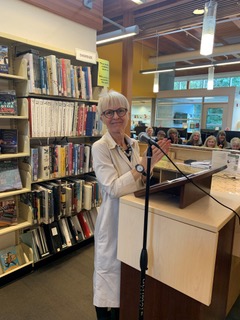
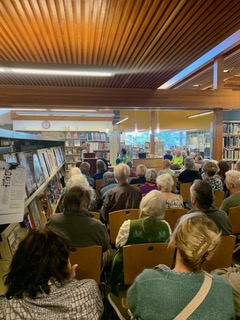
“The talk and reading on 21st September packed the Salt Spring Island Library. This being my home island and likewise that of several others whose stories feature in the book, the audience was fully engaged. As was I. There were family and friends close by and Adina, my bookstore friend as moderator, so my anxieties as to being distracted and subverted by symptoms such as dyskinesia (repetitive, restless movements/ writhing) faded and I could enjoy presenting my work to the audience and appreciate both the laughter and the tears (including my own). Many thanks to all who attended, to Karen and Sophia at the library who set things up so well and to the Writers’ Union of Canada/Canada Council for financial support.

In This Faulty Machine

A Memoir of Loss and Transformation

“An eye-opening, often lyrical and very funny report from that “other kingdom” of illness, from an observant, wise, and honest involuntary resident. The author’s acute yet welcoming voice draws us into the erratic, intimate, and troubling effects of the disease and its impact on her relationships alongside the pleasures of family, friends, reading, writing, and the natural world….”

https://www.penguinrandomhouse.ca/books/788772/in-this-faulty-machine-by-kathy-page/9781037800894


The Exquisite Cyclops

“The Exquisite Cyclops,” a new personal essay by Kathy Page, will appear in the next issue of Canadian magazine of ideas and culture, Geist. https://www.geist.com/writers/about

Always a versatile writer, perhaps best known for her fiction (titles include Dear Evelyn, a Writers’ Trust Prize winner, and two Giller–nominated short fiction collections, Paradise & Elsewhere and The Two of Us), Kathy Page now faces the challenge of living with Parkinson’s Disease. The ability to create fictional predicaments has abandoned her (or she it), replaced by a desire to explore and chronicle the physical realities, philosophical perplexities and many ironies of her new situation. “Which is,” she dryly remarks, “more interesting than you might expect. “The Exquisite Cyclops” is the second part of that ongoing project to be published, following “That Other Place,” which first appeared TNQ https://tnq.ca/ and was selected by Mireille Silicoff as a Best Canadian Essay of 2023, Biblioasis 2023.

Off the Record

Robert Weirsema reviews Off the Record in the Toronto Star

“Metcalf’s latest project, the anthology OFF THE RECORD brings together six of the writers with whom Metcalf has worked, in what becomes a dazzling collection of memoir and fiction. If Caroline Adderson, Kristyn Dunnion, Cynthia Flood, Shaena Lambert, Elise Levine, and Kathy Page aren’t quite household names, OFF THE RECORD is a powerful argument for just what a mistake that oversight is.

John Metcalf, who celebrated his 85th birthday on November 12, is the rarest of commodities: an editor who has gained fame in a position which, usually, goes unremarked and unheralded. Also a noted writer in his own right, Metcalf worked for more than fifteen years at publishers Porcupine’s Quill, and twenty years at Biblioasis; in that time he has helped shape Canadian literature for successive generations.

Metcalf’s latest project, the anthology “Off the Record,” brings together six of the writers with whom Metcalf has worked, in what becomes a dazzling collection of memoir and fiction. If Caroline Adderson, Kristyn Dunnion, Cynthia Flood, Shaena Lambert, Elise Levine, and Kathy Page aren’t quite household names, “Off the Record” is a powerful argument for just what a mistake that oversight is.

Each section begins with an autobiographical essay, of sorts, from the featured writer. Shaped by Metcalf’s “continuing questions,” the editor has stepped in to remove any evidence of those interviews. “To leave in the questions once they’d been answered,” he writes in the book’s foreword, “seemed to me rather like leaving up unsightly scaffolding when the building was finished so I removed them all enabling the responses to flow as seemingly unprompted narrative.

That decision, to strip away the artifice and leave the author’s voice to stand on its own, is a hallmark of Metcalf’s editorial approach. Here, it results in a succession of powerful personal narratives, ranging from each writer’s childhood experiences (generally unhappy, often powerfully conflicted, which likely doesn’t come as too much of a surprise) to their early successes (often with a nod to Metcalf’s role as editor), and including insights into their processes, their perspectives on writing, and their interpretation of their role as writers.

The experience of reading each of these stories after reading their paired essay offers a uniquely insightful experience, as one can trace the impact of each writer’s recounted histories and insights within the fiction itself (“death of the author” be damned). Kathy Page’s unprepared immigration from England to Canada, for example, accounts for what she refers to, in her essay, as why it has taken her “a while to get to the point of tackling Canadian settings and characters” in her fiction. “Low Tide,” the story which follows, demonstrates a bridging of those two worlds: it’s a story set, largely, on the sea and in a light-keeper’s cottage, its setting bringing to mind Canada’s west coast while its concerns and voice resonate with Page’s English upbringing…”

Full text https://www.thestar.com/entertainment/books/in-their-own-voices-six-canadian-woman-writers-on-the-stories-that-shaped-them/article_aacc8e12-906c-11ee-801e-9f7b581abe3d.html

Kathy Page’s “That Other Place” selected for Best Canadian Essays 2023

This personal essay about a devastating diagnosis and its consequences was first published in TNQ and has enjoyed hand to hand circulation since. Now available in this selection of best Canadian essays chosen by Mireille Silcoff and published by Biblioasis.

https://www.facebook.com/photo/?fbid=592431572885397&set=pb.100063556781453.-2207520000

A Secret Garden, with Hollyhock

Sept 17-22 at Hollyhock on Cortes Island, I’ll be co-facilitating A Secret Garden: Writing Childhood Memories with the wonderful Caroline Adderson. It’s a workshop/retreat that focuses on accessing childhood material and points of view and how to use them in your writing, whether that be memoir, fiction, writing for children, or purely personal.  Participants will be in all stages of their writing journey. The purpose of the workshop is to generate the material, so you don’t have to come with anything already written, but you can.  We’ll spend about an hour on guided writing in the morning, then everyone goes off to write.  One on one sessions are available in the afternoon. We’ll meet again after dinner to share, discuss, and consider.  To prepare, try to gather as much childhood material as you can — photos, memories, etc.  Reread the books you loved at that time. We’ll give more specific instructions closer to the time. Time travel is possible! NB Early bird discount runs until 18 June.

Link to Hollyhock page

Trees

Forthcoming in April 2022 is Worth More Standing: Poets and Activists Pay Homage to Trees, an anthology edited by Christine Lowther. Two poems by Kathy Page are included, among work by ninth Parliamentary Poet Laureate Louise Bernice Halfe-Sky Dancer, GG winner Arleen Paré, Canadian icon bill bissett, Griffin Poetry Prize winner Eve Joseph, her husband ReLit Award winner Patrick Friesen, decorated cultural redress giant Joy Kogawa, Fiona Tinwei Lam, Harold Rhenisch, Jay Ruzesky, John Barton, Kate Braid, Kim Trainor, Kim Goldberg, Pamela Porter, Patricia and Terence Young, Russell Thornton, Sonnet L’Abbé, Susan McCaslin, Susan Musgrave, Tom Wayman, Trevor Carolan, Yvonne Blomer, Zoe Dickinson and the late Pat Lowther. The link includes the full list of contributors and contents: https://caitlin-press.com/our-books/worth-more-standing/

Book jacket image showing a moss- swathed tree

The Story of My Face

“I’m waiting for the right person and the right place. When those come together, fit like a key into a lock, then the other person will know it too.”

The Story of My Face

“A marvellously well-crafted book, subtle and measured yet with the powerful tug of deep and dangerous water…” Sarah Waters.

The Story of My Face is the story of Natalie Baron, a teenage girl adrift in the world and looking for someone or something to latch on to. Her seemingly innocent involvement with Barbara Hern and her family, followers of an extreme protestant sect, leads to the revelation of a long-kept secret and a devastating series of events which change not only her face but also the course of her life. The Story of My Face is both a stunning psychological thriller and the archaeology of an accident which shaped a life.

The Story of my Face was long-listed for the 2002 Orange Prize .

First published by Weidenfeld and Nicholson, 2002, hbk, and Phoenix, 2003, pbk. Reissued by Biblioasis August 2019.

Read:

Comments and Reviews

About Face:
 On Writing The Story of My Face
Excerpt from The Story of My Face

Reader’s Guide to The Story of My Face. Download PDF Format.
Reader’s Guide to The Story of My Face. Download Word Format

Buy The Story of My Face from Munro’s Books

Dear Evelyn Wins Butler Prize

Almost a year after receiving the Rogers Writers’ trust Prize for Fiction, Dear Evelyn was awarded the City of Victoria Butler Prize on October 9th 2019.

From Jane van Koeverden at CBC: Kathy Page’s novel Dear Evelyn has won the 2019 City of Victoria Butler Book Prize, a $5,000 award given to the best book of fiction, nonfiction or poetry by an author from the Greater Victoria area.

The Victoria Children’s Book Prize, another $5,000 award, was given to Sterling, Best Dog Ever by Aidan Cassie.

Page’s historical novel tells the story of a marriage as it unravels over seven decades. Harry, a poetry lover, and Evelyn, the ambitious daughter of a drunk, get married shortly before Harry is deployed overseas during the Second World War.

The novel continues after the war’s end, as parenthood and career pressures widen the fissures in Harry and Evelyn’s uneasy marriage.

Dear Evelyn was inspired by the love letters Page’s father sent to her mother during the war.

“They were very passionate, emotional letters. I was struck by the huge distance between this beginning and where things had ended up in their 70-year-long marriage,” said Page in an interview with CBC Books in October 2018.

Page won the 2018 Rogers Writers’ Trust Fiction Prize for Dear Evelyn.

Link to CBC content including “Kathy Page on how to write great fiction that’s based on real life.”

https://www.cbc.ca/books/dear-evelyn-by-kathy-page-wins-5k-city-of-victoria-butler-book-prize-1.5316310

Dear Evelyn nominated for the City of Victoria Butler Prize

Dear Evelyn has been nominated for the City of Victoria Butler Prize. Nominees are as follows:

Robert Amos (non-fiction) – E.J. Hughes Paints Vancouver Island (TouchWood Editions)
Lorna Crozier (poetry) – God of Shadows (McClelland & Stewart)
Esi Edugyan (fiction) – Washington Black (Patrick Crean Editions)
Darrel J. McLeod (biography) – Mamaskatch: A Cree Coming of Age (Douglas & McIntyre)
Kathy Page (fiction) – Dear Evelyn (Biblioasis)

The nominees will be celebrated and the winner announced at a Gala in Victoria on October 9th beginning at 7:30 at the Union Club in Victoria. Tickets available. Full details here.

A Lovely Pairing: Dear Evelyn and An American Marriage

Donna Bailey Nurse compares Dear Evelyn and An American Marriage on The Next Chapter, and talks to Shelagh Rogers about both novels, which feature passionate love letters, separation, and women who step out of their marriages….

https://www.cbc.ca/radio/thenextchapter/full-episode-sept-7-2019-1.5271416/why-if-you-liked-tayari-jones-s-an-american-marriage-you-ll-enjoy-dear-evelyn-by-kathy-page-1.5272235

https://www.cbc.ca/radio/thenextchapter/full-episode-sept-7-2019-1.5271416/why-if-you-liked-tayari-jones-s-an-american-marriage-you-ll-enjoy-dear-evelyn-by-kathy-page-1.5272235

Dear Evelyn on Books of the Year Lists

The Literary Hoarders’ end of year review:

Harry and Evelyn are 1 in Most Memorable Characters, the book is 3 in Most Beautifully Written Book, 5 in Best Books Read and 5 in Top CanLit….Even the jacket gets an honourable mention. Thanks, Penny! http://www.literaryhoarders.com/pe…/2018-year-end-in-review/

A  Globe 100 Best Book of the Year:

“Although the historical events of its backdrop, the Second World War in particular, clearly influence the family’s lives, the story remains personal and intimate in focus. What this painstaking and painful account of a marriage relies on, as much as its period detail, is its precise ruminations on the nature of affection and resentment, and on how love can persist in the face of cruelty.”  https://www.theglobeandmail.com/arts/books/article-the-globe-100-our-favourite-books-of-2018/

One of five  Quill & Quire Critics’ Corner Books of the Year:

“Kathy Page’s Dear Evelyn, a beautifully crafted portrait of a marriage, is definitely one of my books of the year. The novel depicts its characters’ journey from love to alienation with ruthless clarity, but it also fosters the kind of tenderness toward them that we all hope to find in our own imperfect lives.” https://quillandquire.com/omni/books-of-the-year-2018-critics-corner/?fbclid=IwAR3bOQtfaO4cpWNRX5KhHtqgM1IaE-B3icOkmFkF6oDzN9-i7Uzmy3GMROQ

CBC Books Winter Reading List: 15 Canadian Books to Read This Season:

“Winner of the 2018 Rogers Writers’ Trust Fiction PrizeDear Evelyn is the story of a war-time marriage that withers over the course of 70 years. Harry Miles is an English poetry lover who falls in love with Evelyn, the ambitious daughter of an alcoholic, before shipping off to serve in the Second World War. “ https://www.cbc.ca/books/the-cbc-books-winter-reading-list-15-canadian-books-to-read-this-season-1.4914771?fbclid=IwAR3Vst4C5vq8pVoKN3BflDpIvUsyI4rscG6U61iJLpKGZ47aR_qWEFcKbow

The Toronto Star’s Top Ten Books of 2018:

“Page won the Rogers Writers’ Trust fiction prize for this book, an historical fiction novel that was at once deeply personal, based, as it was, on her own parents’ letters, and that touched a profound emotional chord…. ”

https://www.thestar.com/entertainment/books/analysis/2018/12/14/theyre-the-best-the-stars-top-ten-books-of-2018.html?fbclid=IwAR1i7WCZreSi5wwyZ9ExW6WozYEPko0yWXFOUGW1Z-gndoavSspMnzsy7Bo

Kirkus Best Fiction  of 2018

“A searching, and touching, depiction of the places where married lives merge and the places where they never do.” https://www.kirkusreviews.com/issue/best-of-2018/section/fiction/?page=9&fbclid=IwAR0l3EF90YcoUg7ApGnTjivEFO0fcoFvPgF1lQAKA6gzFkzkO-39WmM09vc

49th Shelf Books of the Year 2018:

“Kathy Page has written a story of a marriage that spans the time period between the WWI and WWII and after, a lifetime of this couple, Evelyn and Harry, whose characters are so well drawn that you feel you are inside of their story. Their relationship just barely gets started when Harry, after enlisting, is sent off to fight in Tunisia. And we follow Harry there through his letters home to Evelyn. This is not a perfect marriage, but this is a perfect telling of it!

https://49thshelf.com/Blog/2018/29/2018-Books-of-the-Year-Fiction?fbclid=IwAR21FvyYMbYfGyzy5JP9g3WqtUVxj763EyFrffhubjBilDNafvbKWFhcSqM

Winnipeg Free Press Top of the Pile:

Dear Evelyn is a smartly written portrait of a 70-year marriage between Harry and Evelyn set against a backdrop of a world war and the decades that came after. Sometimes sweet and sometimes painful, it is likely to leave readers with a tear in their eye.”

https://www.winnipegfreepress.com/arts-and-life/entertainment/books/top-of-the-pile-502720622.html


Dear Evelyn awarded the Rogers Writers’ Trust Prize for Fiction 2018

Dear Evelyn  is  the winner of the 2018 Rogers  Writers’ Trust Fiction Prize.

The jury citation reads:

“Kathy Page’s Dear Evelyn tells the tender and unsettling story of working-class Londoner Harry Miles and the ambitious Evelyn Hill who fall in love as the world around them goes to war. What initially begins as a familiar wartime love story morphs into a startling tale of time’s impact on love and family, as well as one’s complex search for  personal meaning and truth. By integrating themes that are universally understood by readers and skilfully crafting endearing characters that surprise and delight, kathy page has created a poignant literary work of art. The result is a timeless page-turning masterpiece.”

Information about the Rogers Writers’ Trust Prize

VIDEO:  Dear Evelyn Writers’ Trust video

VIDEO starting  minute 59: Presentation of the Rogers Writer’s Trust Fiction Prize and “speechless speech” from Kathy Page

VIDEO: BT interview the morning after the awards

Macleans: Here’s the the prize for facing parents and siblings head-on

Kathy Page, Elizabeth Hay among Writers’ Trust winners

Quill and Quire

Dear Evelyn by Kathy Page reviewed in Guardian UK

Elizabeth Lowry reviews Dear Evelyn in The Guardian: “Page’s eighth novel is many things: a love story, a coming-of-age story, and a brilliantly evocative sketch of Britain in the 20th century…..

Its picture of Evelyn herself is authentically troubling, a study of a woman in the grip of terrible compulsions. The warning signs are there from the start, in her panicky housekeeping (“things were much better after she’d spoken with Harry about the accumulation of books and the fussy, old-fashioned effect it gave a room, especially since his book jackets did not match”), her rigid washing and vacuuming schedules, her obsession with hunting down missing pillowcases. Later she is prone to sudden explosions and to punitive silences that last for days: “There was a line between strong-minded and outrageous that Evelyn now crossed with increasing frequency.” Harry, going into contortions to pacify her, says that while “he could bend, she could not”, but Page is after a darker truth. Under the cover of a domestic history, she has ambushed us with a chilling account of a disordered personality. Evelyn, trapped in her trophy house, is every bit as much a casualty of her time and place as her browbeaten husband. Page’s measured, intelligent novel treads nimbly around this bleak terrain.”

Full text here: https://www.theguardian.com/books/2018/oct/12/dear-evelyn-kathy-page-review


Evelyn, Harry and the Sick Rose

From the Ormsby Review:  Dear Evelyn, the 8th novel by Kathy Page of Salt Spring Island, concerns the courtship, love, and marriage of Harry Miles and Evelyn Hill from the tumultuous early days of the Second World War to their deaths decades later. I know of no contemporary writer who deals so convincingly with love,” writes Paul Headrick “Page consistently dramatizes the ways in which the feelings of intimate couples are puzzling mixtures of hope, lust, genuine caring, resentment, politics, and much else.”

Full text here  (does reveal plot)

The Two of Us: “the works of a master who seems to have tapped into ancient troubles bubbling up in our struggling world.”

The Two of Us

by Kathy Page

Reviewed by Paul Headrick in The Ormsbury Review

From Gallant to Kafka

In “The House on Manor Close,” the opening story of this collection, a woman recalls her childhood with an older sister who was obsessed with birds: “I began to think that when she grew up she would become not an ornithologist but an actual bird.” Her fanciful speculation isn’t actually implausible, for in Page’s work we can be in the territory of Mavis Gallant at one moment and Franz Kafka or even Ovid the next. Her characters manage to inhabit the subtly psychological world of literary modernism while also belonging to the unpredictable, shifting landscapes of much older literary genres.

Page’s previous book, Paradise & Elsewhere (Biblioasis, 2014), an astonishing collection of contemporary folk-fairy tales, brought this ancient/modern element into relief, but it’s present as well in these stories, which are more realistic, at least on the surface.

Several that begin the collection are about elderly parents and their adult children. The parents need help that their offspring mostly fail to provide, burdened as they are by old, generosity-killing resentments. “Why are we like this,” asks the narrator of “Snowshill,” after a failed outing intended to cheer her enfeebled father and passive-aggressive mother. “Why can’t we all see how little time there is left?” The grudging reconciliation that follows seems dependent on shared self-deception.

In “The House on Manor Close” the mother exercises a weird tyranny, in part by feeding each of her three daughters differently, rewarding and punishing with dishes they like or despise. When her girls grow up and leave, alienated and angry, she and her husband indulge their passion for gardening, succeeding with plants as they never could with their girls: plants have potentials but not wills. The individual troubles here are entirely convincing while at the same time evoking the force of archetypal generational conflicts.

“Different Lips,” one of the strongest of these enthralling stories, is a variation on The Beauty and the Beast tale, which Page has explored before with startling effect in her novels. The character needing redemption in “Different Lips” is Beauty, not Beast. Jessica is a self-centred, damaged young woman who long has traded on her looks but who finally discovers herself desperate, out of money and friends. She travels across town to see an old lover whom she knows still yearns for her, and she hopes for sex, her only way of making connections.

A funny and cruel reversal greets her, no redemption at all, as her former lover’s lips are grotesquely swollen from an allergic reaction. After their wretched encounter, she struggles to make a last attempt to reach out to him and to save herself. The narrator pauses to describe the scene that Jessica passes:

The cheap restaurants and pubs nearby were filling up. People spilled out on to improvised terraces or else just leaned on walls, glass in hand. A few parents pushed slack-faced, sleeping children homewards, the older siblings, occupied with bright coloured drinks and ice creams, trailing behind.

The carefully chosen words — “cheap,” “improvised,” “slack-faced,” “trailing” — establish a continuity between the alienated main character and the failed world she inhabits, winning the reader’s recognition and deep assent in a way that contributes to the power of Page’s work.

The exceptions in these stories, the characters who are able to love, still feel a pull toward self-interest, but they choose to resist. In “The Right Thing to Say,” Don and Marla wait to discover whether she has inherited an incurable disease and to decide, if the news is bad, whether she will have an abortion. Don knows that he will also need to decide whether he is even capable of staying with Marla. The story echoes a fine Page novel, The Find (McArthur & Co., 2011), in which a couple faces a similar revelation.

In both cases, in the manner of the most gripping of folk tales, the tension-filled situations dramatize a choice that on some level we all must make, with the same ultimate consequences. (The story also gracefully alludes to Hemingway’s “Hills Like White Elephants,” and it’s a mark of Page’s accomplishment that this move doesn’t seem at all audacious.) Don’s eventual response, which forms the resolution of “The Right Thing to Say,” is a brilliantly fitting surprise.
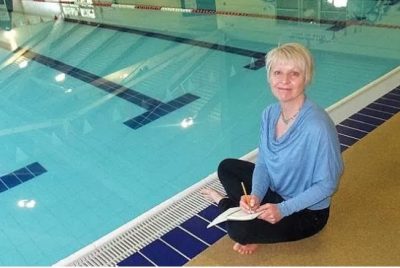
Kathy Page

“Open Water,” the final story of The Two of Us and the longest, creates both the most realistically detailed world and the most impressive dramatization of the way that for Page realism and myth are one. Mitch, a swimming coach, gets a big break — out of nowhere, Tara, a prodigy. Mitch must proceed cautiously in order not to put off the girl’s parents, who are unenthusiastic about the extreme time commitment required by competitive swimming. He also needs to be cautious when Tara, on the verge of elite success, considers quitting swimming altogether.

Once again the story is about parents and children. In some ways Tara becomes closer to Mitch than to her mother and father, who are preoccupied with their other children, and with their own conflict — they separate when Tara is in her teens. We learn through flashback of Mitch’s childhood and his own mother and father, familiarly self-absorbed. “‘It’s tough having parents who ignore what you are,’” Mitch tells his wife when recounting his past.

The decision that Mitch helplessly awaits — Tara’s decision — isn’t as life-and-death as the impending news in “The Right Thing to Say,” but still it’s elemental, as the story consistently draws the reader’s attention back to the importance of water and the image of a person moving through it. “‘What the hell is it about?’” Tara’s mother asks Mitch of her daughter’s swimming life. “‘Being in the water,’” Mitch replies.

Earlier, Mitch recalls his lonely childhood at a boarding school that was precisely wrong for him, and the moment when he discovered the school’s unused swimming pool: “He remembers how his heart lifted, how he almost cried when he saw it. Just the sight of the water, the thought of being immersed.”

So Tara’s choice takes on that special Page quality: will she live on land or in water, choose realism or myth? How will Mitch, her proxy father, straddling both of these worlds, respond? With exquisite timing the answer confronts us with the immense stakes for Mitch and for all of Page’s characters in these stories, the works of a master who seems to have tapped into ancient troubles bubbling up in our struggling world.


Link to original review:

#297 From Gallant to Kafka


Alphabet

What will she be like? he thinks. I don’t know.
Who will I become? Ditto. A leap in the dark…

“…a wonderful book, peculiar, intense, revealing, challenging, exhausting and above all riveting…I kept saying to myself, how could she know this?” Guardian (UK) columnist Erwin James (author of A Life Inside)

Simon Austen is serving a life sentence for murder. Intelligent but illiterate, charming but also damaged and manipulative, he admits to what he’s done but his motives are far from clear, even to himself.

Then Simon learns to read and write. From his high security prison he begins an illicit correspondence with a series of women. The more he learns – about them and about himself – the higher the stakes become. Simon finds himself on a perilous and unpredictable journey as he stumbles towards self-knowledge and redemption.

Alphabet is not just highly readable, but one of the strongest, most eloquent, most tightly constructed novels of  the year…It is a measure of the quiet artistry of Alphabet that, out of material that would have been at home in the blackest of black comedies, Kathy Page has celebrated, with rare deftness, the resilience of the human heart.” Sunday Telegraph

“Sometimes novelists go too far – and sometimes they manage to demonstrate that too far is the place they needed to go.” Time Out

Published by Weidenfeld & Nicolson, UK, in July 2004 UK; released October 2004 in Canada by McArthur & Company. Finalist for a Governor General’s Award in 2005.  First published in the USA by Biblioasis, 2014.

Alphabet by Kathy Page, US jacket by Kate Hargreaves“A moving novel about knowledge, self-awareness and the power of words, set in the purgatory of prison. This young man’s life demands our attention and refuses to let go.” Kirkus starred review

https://www.kirkusreviews.com/book-reviews/kathy-page/alphabet-page/

Reviews and Comments

Purchase Alphabet from Munro’s Books

Continue reading Alphabet

Frankie does time travel

450px-Street_of_terraced_housingI  began work on Frankie Styne and the Silver Man in Norwich, in 1990, and it was inspired by both my  interest in  monsters and my living situation at the time: a terraced house, as it is called in England (row housing), with very thin walls.  Most of these houses were built in the late nineteenth century as housing for railway workers and other working class people. Little thought was given to privacy, and  just a single course of bricks and a  skin of plaster  divides one home from the next. I could hear  a great deal  of my neighbours’ lives – and they mine, no doubt, though I was fairly quiet, due to writing so much. It was sometimes hard to reconcile what I had overheard with  our polite exchanges in the street or over the fence. I began with the  characters,  and they, especially former runaway Liz and her baby Jim,  came quickly to life.

I plotted out the basics  of the story on  flip chart paper. Once I began to write (on my  Amstrad PC with its grey screen and blurry green type)  the story unfolded at a fair pace.  I was soon deeply into  themes that have always interested me: how people  use language to connect (or don’t), how the mainstream culture deals with outsiders, what makes us human,  the complications of sexuality, how we depend on stories to make sense of our lives,  and so on.  I  had a lot of fun writing  Frankie Styne. It’s a literary novel,  but there are elements of horror and touches of speculative fiction throughout, and, to my mind at least, large doses of a dark humour.  I write in both a realistic and a  more fantastic mode, and in this novel, I was able to combine both. I was also able to pay homage to Mary Shelley and, less directly, Fay Weldon,  two literary heroines of mine.  Frankie Styne came out in the UK in 1992 to great reviews, but quickly vanished in the publishing upheavals of the time. I always wished it had had more of a life and  so I was both  delighted and just a little apprehensive  when, over twenty years later,  Bilbioasis proposed to publish it for the first time  in Canada and the USA.

This meant that I had to read it. Reading my own books is something I, like many authors,  tend to avoid.  By the time a novel is complete, I  virtually know the text by heart and am heartily sick of it.  The passing of time helped with this. I read Frankie Styne and the Silver Man, and  even though (or perhaps because)  I am in by now in many ways a different person to the one who wrote it, I did enjoy it.  Still,  I had to ask myself whether  it was it still relevant, and did it matter that the characters use landlines and watch  television, that a crucial scene would have been  different if  Viagra had  been invented, and so on? How much to revise?  I’d written this novel,  which features a mother and baby, before having children of my own,  and while it  was mostly well imagined, there were places where I had things to add, and there were  several  important scenes I wanted to improve, but I left the era and as it was, and  decided I was not the best judge of the book’s continued relevance.

Early reviews, see below, have answered that question.  I’m delighted that Frankie Styne and the Silver Man  is  now finding  such enthusiastic twenty-first century Canadian and American readers.

frankiestyneARCcoversmallFrankie Styne and the Silver Man is dark and funny, painful and uplifting, marvellously satirical but never cynical, and thoroughly invested with good faith. Kathy Page is a marvel. This is the very best book that I’ve read in ages, and if I read another half as good in the next few months, that will constitute an extraordinary literary year…     Read more: http://picklemethis.com/2016/02/10/frankie-styne-and-the-silver-man-by-kathy-page/

“Page (Alphabet, 2014, etc.) builds layers of meaning into her exquisite writing. Her favored themes are here—the stark dichotomies of life, the power of language, the way the social system tries and fails to help people, and how saving grace can come from unseen places.” Kirkus starred reveiw

“Frankie Styne and the Silver Man by Kathy Page is a fantastic novel. Character driven, claustrophobic, and deeply weird, it has a haunting, discomfiting quality that lingers with a reader….”   Read more: http://www.thestar.com/entertainment/books/2016/02/08/kathy-pages-frankie-styne-excellent-oddball.html

frankiestyneARCcoversmallFrankie Styne offers a terrific showcase of Page’s singular style (with its attractive high-low mixture of genres), quirky unexpected invention, and attention to the nuances of psychology. Mere words on a page, her creations linger in the mind long after the reading’s done….” Read more: Frankie Styne in Vancouver Sun

“Five years before The Post-Modern Prometheus aired, Page published her own twist on the Frankenstein story in her native Britain (Page moved to B.C’s Salt Spring Island in 2001), now published in Canada for the first time. In her novel, Page draws on similar pulp material – monsters; aliens; an unhappy, childless marriage – and takes her characters to equally dark places. What’s different is how Page’s monsters display a more complex relationship between inner and outer ugliness and find redemption in responsibility….  Frankie Styne still holds up almost 25 years later.”  http://www.theglobeandmail.com/arts/books-and-media/book-reviews/review-new-fiction-from-gemma-files-kathy-page-and-more/article28743088/

frankiestyneARCcoversmall“Kathy Page’s imaginative and crisply written  Frankie Styne and the Silver Man is one of the creepiest novels I have ever read.” Largehearted Boy

“An amazing and unique read from beginning to end, Frankie Styne & the Silver Man by Kathy Page is a deftly crafted work of truly memorable literary fiction that is especially recommended for community and academic library Contemporary Fiction collections.” Midwest Book Review Bookwatch


Kathy Page at Banff Writing Studio Spring 2018

For some time now I’ve had to turn down requests to  work with other writers on their MS, but here is a wonderful opportunity:  Banff Writing Studio.  I’ve taught at Banff before and  can’t wait to return: dedicated students, gorgeous environment, and no distractions—other than the great hikes and delicious meals.

“This program is designed to offer the freedom of unstructured time in accordance to each individual participant’s needs and desired outcomes, in addition the opportunity to work with our esteemed faculty mentors during the five-week program.
Writing Studio also features a weekly reading series, as well as one-on-one sessions with a voice and relaxation instructor to help participants develop their public reading skills.”

https://www.banffcentre.ca/programs/writing-studio


Reading and Workshop at Blackburn Lake

As part of  Canada 150 celebrations at Blackburn lake, Salt Spring Island, on 2nd July  at 10 am,  Kathy Page will be reading from her story “We the Trees” and and talking about the inspiration for the story, as well as  offering a nature-writing workshop. This is part of a two day program of arts and nature events organized by the Salt Spring Island Conservancy. All welcome, free event.

Art and Nature Fest


Stories of Intimacy: Amy Reiswig interviews Kathy Page for Focus Magazine

http://focusonline.ca/node/1124

Kathy Page’s new collection of short stories explores the transformative power of one-to-one encounters.

IN THE GLOBAL VILLAGE, our world has grown so big. Our care and concern is called on by people from around the planet, and we are mentally and emotionally stretched in endless different directions. Locally, too, as Focus showcases, there’s no shortage of capital “B” Big issues to be aware of and involved in. Being engaged is one of the great parts of living in a vibrant community like Victoria, but it’s sometimes easy to lose one’s boundaries and bearings amid the tide of so much outward pull. 

So I found it incredibly refreshing, especially as I was planning my wedding, to take time to breathe deeply within the covers of Kathy Page’s new book The Two of Us (Biblioasis, September 2016). In this collection of short stories, Page invites us to settle into a series of closer relationships, more homey twosomes, and to expand our awareness inside that smaller and deceptively simple dynamic by questioning who we see, who we are and what we might become.

Tucked away on a winding Salt Spring Island road, Page’s peaceful home is the perfect spot to talk about (and experience) the power of the one-to-one. Attention focuses, stories unfold, and the pattern of listening and responding teaches you something about the other and yourself. That transformative kind of intimate interaction is at the heart of Page’s stories in this 200-page collection, each of which relates to what she calls “the most fundamental thing”: the relationship between the self and another. Whether it’s a father and daughter exploring a cave, a visiting professor negotiating culture and communication with her contact in a foreign country, a hairdresser and client who is facing cancer, a young girl and a dog “big as a wish,” spouses, squatters, strangers, Page’s characters find themselves in pairs—some momentary and some lifelong—in which there is an opportunity to change one another and be changed.

“How relationships work fascinates me,” Page tells me: “How a relationship is structured and built, and what that does to you.” Originally from Bromley, England, Page has published seven novels, including a Governor General’s Award finalist and nominee for the Orange Prize, as well as the short story collection Paradise & Elsewhere, nominated for the 2014 Giller Prize. 

But she has also, she says with a smile, had to improvise her day job and is trained as a carpenter and joiner as well as a counsellor and psychotherapist—drawing on an interest to know how she came to be who she was. She has worked in settings that vary from Vancouver Island University to Estonia, a men’s prison and a therapeutic community for drug users. What she has developed is a sharp-eyed and open-hearted curiosity about self and others.

“I’m interested in difficult characters, in when I run up against a difficult person. I find it surprising,” she explains with a lock of her intense but serene sky-blue eyes. “I’m interested to explore them without judgment.” That non-judgmental curiosity not only saved her from resentment when partnered with a somewhat stony carpentry mentor back in England but has made her a writer that pairs probing insight with gentle but direct handling. 

For instance, she tunes into the kind of prickly honesty of thoughts and feelings many of us would feel guilty admitting and would never have the guts to say out loud. She presents an older woman who both loves and is bored—even appalled—by her husband and his now slowness in just putting on his shoes. And a husband, awaiting his wife’s genetic testing results, asks himself: “What if there is bad news? How will I be for her? What will I do, what will I say to her as she turns to me?” He wonders if he will change himself into what is needed or just run. 

Page reminds us of the simple but important truth that we are mystery. We are always more than one thing at a time, and who we are and how we get there isn’t visible at the surface. “From the outside, no one would guess any of this, not in a thousand years,” one young man thinks while reflecting on his various abilities. In another story, a nervous, tongue-tied man turns out to be a surprising lover—“in the flesh, so articulate.” In a short two-pager, a child considers dragonfly nymphs, how “inside, they produced glittering wings, lungs, and enormous eyes” before splitting their skin and emerging new. She wonders: “Suppose we were just the beginning of something else?”

Skills, sorrows, incredible transformations—Page reveals the hidden and encourages us to look for it, to look differently at the people in front of us or beside us in our own lives, to understand, to forgive, and to wonder about our own new beginnings. A trip into her world is, as one of her characters says, “a day for seeing things.” 

Sometimes, Page explains, she begins with just a person or a predicament, other times with something as simple as a staircase. “With short fiction you can improvise,” she says. “It’s freeing. Novels sweep you up in momentum. Short fiction is more like a plunge into the lake” where, Page hopes, you come up and out with a bit of a shock. “You can then sit back and keep the whole thing in your mind.”

Her swimming image recalls a description of free diving in the book’s final story, centred on a swim coach and his prized protégé—a description that applies perfectly to Page’s own writing: “Depth is about the water pushing in on you and separating you from the familiar.” Page’s skill lies in separating us from the familiar by taking us deep into the everyday, making the seemingly typical or unremarkable newly remarkable, from the clink of milk bottles against a step to the slightly moldy smell of damp summer towels and the lake’s response to its swimmers: “The thick green water breaking into golden streaks and swirls with each dive, then resealing itself, perfect each time.” 

“All those things suggest human life,” Page says passionately, “and every human life is full of stories. Everywhere you look or listen, there’s a whole rich story.” 

A plunge into the intimacy of The Two of Us, Page hopes, helps readers to feel they’re in a different place in the end, even if it’s just a change in what we’re able to notice as we come back up for air ready again for the wider world—“more alive,” she says, “and aware.”

Newly married writer, editor and musician Amy Reiswig is extra appreciative of having a new perspective on the power of pairs.

The Two of Us a Best Book of 2016

 GLOBE and MAIL FICTION

THE TWO OF US

BY KATHY PAGE

“One of the most talented short-story writers working today delivered yet another knockout collection that is both darkly funny and terribly sad.”

http://www.theglobeandmail.com/arts/books-and-media/the-globe-100-the-best-books-of-2016/article33132356/

The Writers’ Trust  Best Books of 2016 recommended by Canadian writers

Deborah Campbell
 
“Strife. Division. Tears in the social fabric. As journalism collapses, leaving fake news and social media to compete for our attention, books are one of the last places where complex conversations still take place. Kathy Page’s 2016 Giller long-listed The Two of Us is a collection of stories that explores relationships between pairs of people (not necessarily a couple). She has a dark side and knows how to throw a grenade into expectations…”


QUILL & QUIRE

The Two of Us

Kathy Page
Biblioasis
Following her 2014 collection of fantastical tales, Paradise and Elsewhere, Kathy Page’s newest story collection is notable first as a demonstration of the author’s remarkable versatility. But The Two of Us stands on its own merits: a group of emotionally resonant, poignant examinations of life and love and – most piercingly – death. Page is a highly skilled miniaturist, capable of pulling off powerful effects by way of simple (though never simplistic) prose and a keen eye for human fallibility and ambiguity. –S.B.

Quill & Quire Books of the Year

The Walrus Best Books of 2016

Canadian authors pick their favourite reads

Sonnet L’Abbé

On my bedside table are the books I’m dying to finish when I’m done marking: Kathy Page’s Giller-longlisted The Two of Us, Susan Juby’s Leacock-prize-winner Republic of Dirt, and Kamal Al-Solaylee’s truth-to-power memoir, Brown.

The Best Books of 2016


Psychologically rich & cinematic in the best way, the sweet agony of connection

This review  of  The Two of Us ran in the Ottawa Citizen and the Vancouver  Sun, probably elsewhere,  too.

“Word is, the publishing industry (a business sector conscious of market demand) doesn’t invest much in, or encourage, short story collections. Alice Munro-like exceptions exist, of course, but — word is — that literary genre is regarded as a money pit. In a Walmart world, apparently, any volume of short stories is artisanal, a hand-crafted labour of love: those who seek it out will cherish it, but the majority of fiction readers desire the engagement or satisfaction or dollar value that only novel-length storytelling is thought to bring.

Based on the evidence of Kathy Page’s The Two of Us and Clea Young’s Teardown, though, someone’s mistaken. These collections, 28 stories representing untold hours of art-making effort on their authors’ parts, invite us into captivating worlds. In ten-page allotments, admittedly, but still. Technically accomplished, they’re immersive, emotionally involving (the proverbial laughter through tears), and insightful.

If you’re a short story reader already, here’s another pair to seriously consider. If you’re not, maybe considering giving them a taste. They’re way more satisfying than kale.

For The Two of Us Salt Spring Island resident Kathy Page selected pieces that focus on pairs. Psychologically rich and cinematic in the best way, they showcase Page’s range of interests, clever setting choice, and singular eye.

Usually taking place in the U.K. (where Page once resided), the stories capture assorted moments in time. For instance, just four pages, “Johanna” features the reminiscences of a man whose philosophy decades earlier had been “love often” and “don’t count on me.” Settled now, he wonders if he’d want to meet one of the children he sired. Not quite two pages, “Daddy” relates just an instant in the day of a girl who is about to begin a caving adventure with her father.

Some stories envision intersecting strangers. A lovely scenario, “The Last Cut” portrays a hairdresser shaving the head of a last-minute client, a woman with cancer who then asks for his help in choosing the perfect hat.

Page often examines familial and romantic relationships. “The Perfect Day” follows shifting allegiances between interchanging pairs: a daughter taking her ailing elderly father to a historical landmark with her waspish mother in tow. Her vow — “I intend to keep smiling and move on through the kind of day I want us all to have” — proves difficult to uphold. That story twins with “The House on Manor Close” and “Dear Son,” where the subtle tensions and evolved dynamics of adult children with elderly parents are portrayed with both humour and finesse.

Showcasing lovers — squatters; worried expectant parents with problem DNA; former friends with benefits; an obese couple struggling with prejudice; and a marriage on the verge — Page hints at the myriad possible trajectories any romance might take. Altogether Page offers a master class in fun with numbers, in this case two. She has been longlisted for the Scotiabank Giller Prize for this collection… “

Brett Josef Grubisic, read in the Vancouver Sun.

It’s also a great pleasure to see this  student review in the McGill daily

 http://www.mcgilldaily.com/2016/10/the-sweet-agony-of-connection/

To quote from it: “Sweet Agony is one of the shortest stories from the collection. Page proves that you sometimes don’t need to write a very detailed and long story to describe a loving relationship and evoke an emotional response. It describes two lovebirds making love on a hot day of summer while no one’s home. The story evokes the feeling of nervousness, confusion and awkwardness surrounding being intimate with one’s childhood crush.”

The Two of Us Globe Review

Short  fiction does sometimes garner short shrift in terms of review coverage. It’s a huge pleasure then, to read Steven W. Beattie’s review of The Two of Us  for the Globe, which takes the time to explore one of the stories in depth,  mentions their  “potent” emotional impact, and at the same time defends the genre.

“…Page’s ability to convey large swaths of emotion in just a few simple gestures; she runs circles around authors who work twice as hard for half the reward.”

Here it is, online: http://www.theglobeandmail.com/arts/books-and-media/book-reviews/review-kathy-pages-the-two-of-us-and-sex-and-death-a-new-anthology-of-short-fiction/article32283064/

A Good Start: The Two of Us nominated for the Scotiabank Giller Prize

It’s over a week since I heard from  Dan Wells at Biblioasis that my short story collection, The Two of Us, had been short-listed for the Scotiabank Giller Prize. It was a delicious surprise and is  a great  honour and, but since it happened, I’ve been too busy to post here, and have only been only shocked into action by the Giller Prize tweeting an invite to my website yesterday.  giller-screen-shot-2016-09-15-at-10-14-17-amThis is rather like having your parents visiting unannounced, and a bit of belated house-keeping seems in order, so here I am,  – delighted, too, with the first review from Quill and Quire:    http://www.quillandquire.com/review/the-two-of-us/
My previous collection of stories, Paradise & Elsewhere was  long-listed for the same prize in 2014. The two books are very different,  so this adds to the pleasure of the current nomination in that I feel both sides of my writing personality and interests  have been in some way endorsed. It’s also great  to be  part of what looks to be a very strong and diverse list.  

Many thanks to this year’s jury, Lawrence Hill, Jeet Heer, Kathleen Winter, Samantha Harvey, and Alan Warner – and also to my editor, John Metcalf, and publisher, Dan Wells for all their skilled work and dogged faith in my writing.

kp-twoofus-sq


Paradise & Elsewhere by Kathy Page

Storytellers

A Tale of Four Storytellers

In this thoughtful and illuminating essay posted on AllLit Up,  https://alllitup.ca/Blog/2015/A-Tale-of-Four-Storytellers,  Poet Zachary Wells asks whether Canadian culture is old enough to  make a literature of fantasy, and  concludes with an affirmation that yes, it is, provide we  have an elastic definition of what Canadian is, and can overcome the traditional prejudice against work that breaks out of realist bounds.  Wells includes Paradise & Elsewhere in his survey of  recent fabulist short story collections, which also includes work by  Sean Virgo, Mike Barnes, Molly Peacock and Stuart Ross. Here’s what he says about Paradise  & Elsewhere:

Kathy Page, originally from England, is best known for her realist fiction. Her recently republished prison novel, Alphabet, has been praised for its gritty fidelity to the prisoner’s experience in the English penal system. Page’s editor, John Metcalf, admitted to her that he has a McEwanesque “prejudice against non-realistic writing,” and was therefore reluctant even to read the manuscript of Paradise & Elsewhere (Biblioasis), which Page had submitted at the same time as a collection of more conventional stories. When she prevailed upon him to give the fabulist book a chance, it turned out that he liked it a great deal.

Wells_3

As have many readers and awards jurors, perhaps because of the very archetypal nature of the collection’s tales. Tolstoy, who looked to the art of the peasantry for models, famously said that “all great literature is one of two stories; a man goes on a journey or a stranger comes to town.” The latter plot is crucial to Page’s dark fables. The place where the stranger arrives is not usually a town, per se, but the settings of Page’s stories tend to be hostile, isolated, inhospitable zones. If these are not always “the places where things begin,” as the book’s cover copy proclaims, they are certainly the sort of place, like the Galapagos, where things, be they species or languages or stories, mutate into unique, heterogeneous forms—the sort of place where a stranger’s arrival means trouble.

Indeed, one of the book’s most trenchant themes is the troubled interpenetration of the modern and the pre-historical. In “G’Ming,” the book’s first story, the narrator is Aeui, a teenager on an impoverished island who bilks tourists of money in exchange for “authentic” exposure to village life. While Aeui disdains the gullibility of his marks, he is also contemptuous of his shaman uncle who “sits by the river all day. It seems to me he has no obligations.” The next story, “Lak-ha” is the very brief origin myth for a community that clings to life on an exposed, stony peninsula, supported by the Hetlas tree, the fibrous wood of which, it turns out, is very good for making rope. A chance visit from a foreign ship brings commercial exchange to Lak-ha. The rope trade affords a measure of prosperity to the people, who now “have television, internet, iPod, cellphone, denim jeans, Barbie doll, same as you.”

As in Barnes’ and Virgo’s books, the nature of storytelling, its origins and its future, the imperatives of “objective” journalism or science in conflict with myth, feature prominently. In “Clients,” a fable set in an unspecified future time in which the rage for expertise has infiltrated all aspects of society, a couple hires a professional conversationalist who “doubt[s] that [they] would enjoy a home-grown conversation.” They decide to give it a go regardless and the story ends with them as an Edenic couple, speaking to each other haltingly, making the first hesitant, unmediated forays into language, “a new country, vast, intricate, ours.”

The article is very much worth reading in it entirety. https://alllitup.ca/Blog/2015/A-Tale-of-Four-Storytellers

Dan Vyleta’s Walrus review of Paradise & Elsewhere

A huge pleasure to have this review from Dan Vyleta in The Walrus.

The Short List

Book jacket courtesy of Biblioasis

Paradise and Elsewhere
Kathy Page

Toward the end of Paradise and Elsewhere’s longest and structurally most intricate story, “The Ancient Siddanese,” an enigmatic tour guide to the ruins of a desert city invites the group to “close your eyes and explore Sidda by touch.” The narrator, an inhabitant of a near-future in which the sun has become humanity’s enemy, accepts the invitation and finds an unexpected perspective in his fumbling: that of a hypothetical interstellar tourist who discovers the dried-out planetary lump that was Earth and wonders at the creatures who left their marks on the dead world.

The whole of Kathy Page’s beautiful, daring collection can be read as an invitation to seek out new points of view, with all the discomfort implicit in the act. The opening story, “G’Ming,” stages an encounter between what we so confidently call the “developing world” (as though its primary marker were stunted modernization) and the “developed world” from the point of view of a village boy, whose close observation of tourist behaviour is as shrewd as it is disconcerting. Like all the stories in Paradise and Elsewhere, “G’Ming” remains elusive about its precise setting, sabotaging the reader’s yearning for certainties. It sets the tone for a collection that moves seamlessly from realist accounts of the here and now, to dispatches from our imminent future, to the timeless worlds of myth and dream. It makes for giddy reading: each story’s opening paragraph an unlabelled door that may lead anywhere at all.

In “Low Tide,” we find ourselves deep in Angela Carter territory, where fairy tales are reunited with their latent sexual content to take soundings of the treacherous depths of desire—Hans Christian Andersen’s “The Little Mermaid” reimagined as an abusive relationship between a lighthouse keeper and the creature of the sea he seeks to possess. The next story, “My Beautiful Wife,” is a realist portrait of an eastern European intellectual who is unsettled to find that the democratic revolution has brought in, among its stock of fresh ideas, emancipation; he witnesses his wife becoming other to him, despite his love.

Attempts at communication across lines of gender, wealth, and even species; sudden changes in points of view and their implied reshuffling of certainties—despite the book’s many shifts in genre, protagonist, and setting, the collection has a startling coherence. Like children at a sleepover, tucked beneath shared covers, the stories whisper to one another, providing a thematic richness to the book that far outstrips its page count. As with all good fiction, Paradise and Elsewhere helps us to see more clearly (though clarity is not without its dangers: in “I Like to Look,” the narrator literally observes her sister to death).

The result is a collection that, while neither flawless nor comfortable, is always intriguing, often dazzling, and—for all the bleakness it unearths—immensely fun to read. Page has rebelled against the provincial assumption that we readers care only about the familiar and understood. “We must learn to talk to each other differently now,” Liia tells her husband in “My Beautiful Wife.” It is the awareness of this need that sets this fine book apart from so many others.

Dan Vyleta

https://thewalrus.ca/the-short-list/

Spring Readings on the West Coast

 The snow has long ago melted (or never really settled) here on the West Coast, and the nights are longer, yet not so warm that you want to stay  out gardening: a perfect time for literary readings. I’m taking Frankie Styne and the Silver Man to some great local libraries and bookstores. 

29th March, 7 pm,  Kathy Page reads with poet Alexandra Oliver at Book Warehouse on Main in Vancouver

5th April, 7 pm, Kathy Page reads with  Douglas Gibson at Cowichan Library, 2687 James St, Duncan

6th April 7.30 pm, Kathy Page reads with Douglas Gibson at Russell Boooks,  734 Fort St, Victoria

23rd April,  Kathy Page reads in Sechelt

27th April, 7.30 pm, Kathy Page  reads with  Tricia Dower  at  Mulberry Bush Books, 28o Island Highway, Parksville

29th April,  10 am, Kathy Page on air with Sheila Peters on CICK 93.9


An Evening with Douglas Gibson (Across Canada by Story)

& Kathy Page (Frankie Styne and the Silver Man)

frankie-styne-cover-sqrFrankie Styne and the Silver Man

When Liz Meredith and her new baby move into the middle rowhouse on Onley Street – Liz having lived for years off-grid in an old railcar – there’s more to get used to than electricity and proper plumbing. She’s desperate to avoid her well-meaning social worker and her neighbours Alice and Tom, who, for reasons of their own, won’t leave her alone.  And then there is her other neighbour, the disfigured and reclusive  John Green, better known to the world as Frankie Styne, the author of a series of violent best-sellers. When his latest novel is unexpectedly nominated for a literary prize and his private life is  exposed in the glare of publicity,  Frankie plots  a gruesome, twisted  revenge that threatens others who call Onley Street home.  Frankie Styne and the Silver Man is unforgettable: a thrilling novel of literary revenge, celebrity culture and the power of love and beauty in an ugly world.

           “A fierce writer; her relentless imagination and pure writing skills bring a broken, nightmare world fully to life.”Kirkus Reviews

            “Page’s monsters display a more complex relationship between inner and outer ugliness and find redemption in responsibility.”The Globe & Mail

            “Frankie Styne offers a terrific showcase of Page’s singular style (with its attractive high-low mixture of genres), quirky unexpected invention, and attention to the nuances of psychology.”

Vancouver Sun

           “This book has the trappings of great pulp … Page’s prose is vivid and alive, with nary a scrap of throwaway writing to be found.”Publishers Weekly

           “Frankie Styne is a taut examination of the complex emotional ties that bind, the methods we employ to distance ourselves, and our ambiguous powers of imagination.”Time Out UK

           “Fresh and engaging. Her writing is crisp and her insights into human behavior are acute.”

—Lynne Van Luven, Monday Magazine


 Across Canada by Story

Acclaimed McClelland & Stewart Publisher and Editor, Douglas Gibson, crossed “no man’s land” and entered authors’ territory when he wrote Stories About Storytellers in 2011. The memoir is a fond remembrance of Canada’s elite “literati”: Alice Munro, Alistair MacLeod, Hugh MacLennan, W.O. Mitchell, Barry Broadfoot, Mavis Gallant, Pierre Trudeau, and others. Gibson calls it “a cheerful personal memoir of working with 20 famous Canadian authors, some of whom are still with us.” Gibson’s 2015 title, Across Canada by Story invites readers on a coast-to-coast journey following the Scotsman as he tours the nation with a stage show telling more tales. Often witty, at times tender, and always amusing, the memoir paints a portrait of Robertson Davies, Guy Vanderhaeghe, Terry Fallis, Myrna Kostash, Trevor Herriot and others, with accompanying illustrations by Anthony Jenkins.

  His legendary stage presence radiates on the page and his wit, sincerity, and eloquence – a trait that earns him instant rapport with the reader – makes readers feel they are gossiping with an old friend returned from life on the road. Gibson absorbs the landscape, culture, and history of each province he visits, while treating readers to some amusing rendezvous with authors and other locals along the way: He rediscovers James Houston’s riverside distractions in Haida Gwaii; tastes the wine his wife, Jane, is partial to in Prince Edward County; munches succulent peaches and apricots on the Sunshine Coast; daydreams in the Deer Creek sunshine; goes bird-watching with Trevor Herriot on Last Mountain Lake; visits Anne of Green Gables sites in PEI; and you come along for the ride.